Cover Story: Ike Reilly featuring Shane Reilly • Flaws and Hope in Every Song
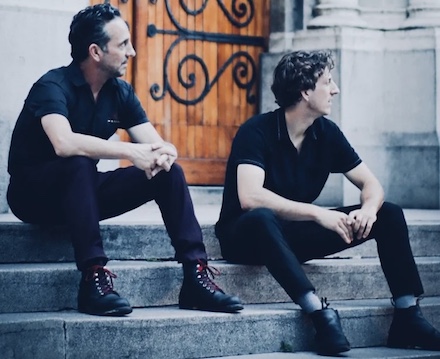
Ike and Shane Reilly (photo by Marlene Monroy)
Annual Take Your Child to Work Day usually occurs on the third Thursday in April. But rasp-throated, political-minded rocker Ike Reilly and his son Shane have inadvertently wound up celebrating it, every single day.
25 years ago, this scrappy Libertyville, IL native found his musical calling rather late in life when he released his cult-classic debut disc, Salesmen and Racists, which was crackling with gruff urban vignettes like” Angels and Whores,” “My Wasted Friends,” and an unusually-grim “New Year’s Eve,” its starkness underscored by a vintage black and white album-cover photograph by 20th century New York crime-scene shutterbug Wee Gee. So after punching the odd-job clock for decades as grave digger, hotel doorman, so many gigs he could barely remember them all, Reilly’s long-foundering career in music caught fire, and his family grew accordingly, with three sons who would grow into roles in his backing band, Kevin and Mickey on vocals, and Shane stepping up as his right-hand man, as co-vocalist, co-guitarist and finally — on their new father/son duets album **Blind and Surrounded — co-songwriter with dad, as well.
Reilly was proud to have the Chicago-based Shane beside him in his home studio in Libertyville, where he still resides, one block from his 99-year-old mother, who lives unassisted in the family house where he grew up. He and his scion both penned six songs in their own idiosyncratic way (read on to learn more about their individual approaches in the following dad/junior interviews, conducted separately), and the senior Reilly added a producer’s ear to the project. And he never took on the heavy role of stage dad, he insists: “I would never, ever lure anyone into this business, and you should only do it if you really, really want to do it. But for Shane, he just had to write, because it’s a cathartic, therapeutic thing for him, and he’s super-disciplined and has a very disciplined life, and writing and playing music is now a part of it.”
The jovial family band vibe? “Well, maybe this wouldn’t have happened without the pandemic,” admits Shane, who took COVID as a sign to give up his Chicago apartment and bunk-bed it at Ike’s place. “So we were basically stuck there together, with all this excess time on our hands, so that’s when I started writing a lot of these songs, and you know, my dad and I are best friends, and I’m closer to him than anyone else.” Some youngsters might shudder at the thought of being cooped up with their folks during an enforced lockdown. “But I think our songs work well together, I like his songs, and he likes mine, and he sings on mine, and I sing on his,” Shane adds. “It works. And I actually think he’s one of the best songwriters in the country, and I’m honored just to play with him.”
Blind and Surrounded blends Reilly genealogy into one streamlined, hickory-smoked melange that’s noir-film tough (“Do Your Best,” “Who’s Been Hurtin’,”“Life and Death in East Moline”), Dystopian-foreboding (“New Bad News,” “Waiting For the Planes,” “and “Bad Bad Man”), and ultimately escapist in the best” Born to Run” kind of way (“Searching For a Change,” the self-explanatory “We Better Get Packed”). Underscoring how father and son’s voices almost seamlessly blend is the wanted-poster-bold album cover headshot of them, rendered in a harsh, exacting retro tintype reminiscent of Richard Avedon’s “In the American West.”
“We also used a similar font to look like my debut, Salesmen and Racists, since this new album is coming out almost 25 years to the very week apart,” reveals Reilly, who also maintains his own Sirius Radio show, Ike Reilly’s Apologies. “I see it all as an homage to our very first record, and the evolution of it all. I mean, I take it for granted, but when I think that these three boys of mine are actually IN my band?” He still can’t quite get over it. But the real reminder of his good fortune rests inside an eternally scrolling digital photo frame on his wife’s desk. He’ll glance at it and see a picture of himself, holding a then-baby Shane in his arms. “And it changes all the time, so then another picture will pop up of Shane and me onstage with Bruce Springsteen, and I’m like, ‘That’s fucking weird!’ Those pictures hit home more than anything else on the actual passage of time.”
And did we neglect to mention that in some fortunate instances, Take Your Child to Work Day just might include some surprise guest stars, like Springsteen, who — via their mutual friend Tom Morello (who financed an in-depth documentary on Reilly, called Don’t Turn Your Back on Friday Night) —invited Ike, Shane and company to open for his January 30 Minnesota benefit show, dubbed, with a prominent exclamation mark, “A Concert of Solidarity and Resistance to Defend Minnesota!” Within two hours of each other, both Reillys sat down for separate chats recently, with some surprising results….
IE: First question: Given your Minnesota summit show with Springsteen, are you regularly in touch with him?
IKE REILLY: I’m not. I’m regularly in contact with Tom Morello. And HE’S regularly in contact with Springsteen. Or periodically. I’m just acquainted.
IE: When was the first time you met him? And what was it like last time in Minnesota, which sounds pretty ominous?
IR: I met him for the first time with Shane at Wrigley Field, when Tom was playing with him at Wrigley Field. It was probably around 2013 or ’14. And after the show, he talked to Tom, Shane, and me for a long time. But I hadn’t really seen him since then.
IE: Where does Bruce fit in your personal songwriting pantheon?
IR: I’m a fan. And I didn’t realize he was a fan of mine, either. I’d heard it, but I didn’t really believe it until he told me point-blank in Minnesota. And I’ve got a gig, I’ve got a show on Sirius Radio, and the head of Sirius told me that Bruce turned him onto my music through my song “Bolt Cutter.” And I’m actually a guest DJ on **E Street Radio tonight, and they’re spinning my cover of “State Trooper,” which we recorded live at the Sirius Radio Studio in New York. And you ask me who my pantheon is, and it’s Dylan, The Clash, Leonard Cohen, Tom Waits, and The Pogues.
IE: How do you select a particular song to cover? You were doing them during the pandemic from home, right?
IR: How do I select covers? If I can pull ‘em off, great. Or if I love the song. But you know, I love songs that I can’t interpret — do ya know what I mean? But “State Trooper” is a song we do a version of, where the character I portray is much more desperate and dangerous than the one on his album. Mine is running from something.
IE: Shane said he doesn’t write desperately from real life —he imagines every last hardscrabble detail of his characters. But you write differently, more inspired by real life. So did you ever personally explore decadence then?
IR: I’ve had a lot of experiences. And if a songwriter is gonna tell you “I’m a dangerous man,” I wouldn’t believe him— that’s a narrative he’s building. But I can’t speak to how Shane writes. We don’t talk about it. He just comes in with songs. So I don’t talk about his creative process, and he probably doesn’t know about mine. But I help him find the songs, you know? When he writes a song, I’m there as a producer. And I’ve written songs every single way. I’ve lived a long life, I’ve had a lot of jobs, and I’ve traveled a lot. But I’m not a felon, and I’ve never been a junkie. And I am an alcoholic, but I don’t consider my life to be hardscrabble. I’ve had a lot of jobs. I’ve worked as a grave digger, I worked as a doorman, I’ll do whatever I gotta do. But, like Shane, I also have a good imagination, and I’ve been heavily influenced by books and movies. Marlon Brando is from Libertyville, and when I was eight years old, I found out about that, and I sought out every one of his films I could find. And I found myself identifying and looking up much more of the characters in those films than in the pursuit of a thespian’s life.
IE: In your song “New Bad News,” you note that “there’s not much left in the tank.” But I began to notice that a car figures into almost every track on the record, even if you’re just packing to leave, with an automobile waiting outside. Even in the final song, “Gone Forever,” there’s an escape, either via vehicle or maybe death itself.
IR: I think it’s death, his song. And he can think what he wants, but everybody I know thinks it’s death in that song. Either death or loss. But when we play that song for people who have never heard it, people are not only singing along at the end, but a lot of ‘em are crying. But you know, there’s some sorrow and sweetness in his songs. And I can’t analyze his songs like a writer would, but I know it when I see it. Some things, I don’t know what exactly he’s talking about, but I know that he has this quality to his voice and delivery that’s soothing and sorrowful, you know?
IE: Well, before moving to San Francisco in ’82, just to see The Cramps three times in a row, I hailed from total car culture in Indianapolis, but I haven’t driven one since then. Can you trace your own evolution in Midwest Car culture through the various models you’ve owned? I was always a Chevy man.
IR: I had five Impalas. In the late ‘70s or early ‘80s, you could get a ‘60s Impala for $50 or $100. So I had many. I think I even had a song called “1,000 Impalas” or something like that. I never recorded it, but I did it to the melody and rhythm of “The Midnight Hour.”
IE: The weirdest thing was when Shane said he’d never actually owned a car.
IR: Ha! Yeah, he lives in the city, and he hasn’t. His brothers love cars. But not Shane. Did he tell you I was a gearhead who loves cars and bikes? I’ve had a ’65 Cadillac, I had a ’69 Galaxy, I drive a 2020 police-package Dodge Charger — that’s my latest car, with a 5.7 liter V-8 in it. And I bought it right before the war, and I am just going broke, filling it up and driving fast. But it’s cool as shit, and it’s black. I’ve got a ’73 Honda 350 that I rip around in, and every time I go into a gas station, some guy between the ages of 52 and 85 comes up and says, “I LOVE the smell of that! It reminds me of my childhood!”
IE: What are some of your favorite books?
IR: Well, it’s a cliche, but East of Eden. I generally like all the classics. I like Confederacy of Dunces. It makes me laugh very hard. But I also like the fact that the main character’s got the last name as ours, and it’s spelled the same way. I’m reading a book right now about the relationship between slaves and overseers in the South, and it’s very uncomfortable. But I like historical biographies — Franklin, Jefferson. I think if I had to, I could live off of biographies.
IE: You signed your first recording contract at 38, 40. Why then? And what’s so bad about grave digging anyway?
IR: Aw, nothing was bad about it. I was just young. I was a cemetery worker who occasionally got to run a backhoe. But you know…I got married, and then I moved and started working in the city — the money was way better as a doorman. But the whole time, I was just trying to find a way to express myself, some way. So I was a doorman at the Park Hyatt, so I worked there while I started the band, and I was there 13 or 14 years.
IE: Did you schlep luggage for anybody cool?
IR: I met everybody. I met Keith Richards, the Dalai Lama, Richard Nixon, Clinton, Bob Newhart, and Pearl Jam — I introduced myself to them. One time, Elvis Costello was staying at the hotel, and I knew he was gonna go do something live on the radio. So I went up to his room, sat, and played the acoustic guitar he’d left for about an hour.
IE: Uhh, maybe we’d best not repeat that during the interview.
IR: I repeated it on the air on Sirius Radio about two weeks ago.
IE: I asked Shane if there was any hope for your album. And it feels like he himself is optimistic, while you more readily see humanity’s flaws and imperfections.
IR: Yeah. But I also see the beauty in imperfection. It fascinates me to write about that. And I know Shane is more hopeful, and he should be. And I’m not hopeless, but generally, my songs are conversational characters, snapshots, impressionistic themes, where you may get something from these characters — either through description or their own words — that might lead the listener to believe that these people are struggling and in a bad state. But that doesn’t necessarily mean that I’m personally hopeless. I think I’m just empathetic to people that are invisible, you know? And I think maybe those are the people who are struggling, financially, emotionally, or with medications and alcohol. Or people who feel voiceless, invisible, you know? And I think maybe those are the people that inhabit some of the songs. And with a song like “Do Your Best,” you’ve got a guy — or whoever the character is — who’s trying to find somebody to get intimate with in a casino while he’s losing all his money, and it’s kind of tongue in cheek, like “Do your best — that’s all that you have. Are you a finalist? Are you gonna win? Or are you just a participant?” Everybody now gets a medal put around their neck, and it’s like you don’t really have to win anymore. So the contrast is tangible. I think in this group of songs, you would definitely feel more hope on Shane’s batch than my batch. But our presentation is just a little different — there’s a little more earnestness in some of his songs.
IE: The album title is pretty stark, though — Blind and Surrounded. The last report you want to hear from your soldiers at the front. And the line came from your track “Waiting For the Planes,” which feels eerily like a conspiracy theory.
IR: I wrote “Waiting For the Planes” as…well, if you were to recite that as a voiceover to a noir film — “The city’s got a pounding headache.” I don’t sing it that way, but that was the approach, so “Waiting For the Planes” is a nebulous warning, like” What the fuck else could happen?” But that’s also tabled in this B Section of the song that talks about what a wonderful day it is, so there’s a lot of division.
IE: How old are you now?
IR: I’m the age of that Beatles song, “When I’m 64.” But I’m still feeding myself. And my mom is 99, and she lives just a block away — she lives on her own in the house I grew up in. She’s a little slow on foot — she’s got a walker, but she’s of perfectly sound mind.
IE: So what’s your take on mortality now?
IR: Uhh..I’m against it. But you know, my hope is that somehow, we’re all united in some cosmic, spiritual way. But I have no belief in any of the Judeo-Christian beliefs about the afterlife. I believe we’ve gotta make hay while the sun shines, ya know?
Q&A with Shane Reilly
IE: How’s your health, you and dad?
SHANE REILLY: Right now, we’re not dealing with any illness. There’s some illness with… you know, you know…Luckily, we’re healthy and super-fit, and we try to work out as much as possible to stay mentally and physically fit. Sooo…no illness! So we’re both lucky for that. And I think we’ve just always been that way. We want to live as long as we can, and my dad was a runner in high school and still runs every week, almost every day. And I was a college track athlete, and I dunno — I think it’s just so important.
IE: I interviewed John Fogerty’s kids recently, who have their own band. And my first question to them was, “Guys — when did you finally notice, ‘Hey — my dad is really fucking COOL.’”? When did you notice that about your dad?
SR: I knew that really early on, because Libertyville, Illinois, you know…either you work for a Pharma company or you’re a teacher. And I would go over to my friends’ houses, and early on, you find out what your friends’ parents do for a living. Then I would go back home, and I’d be like, “This is not what anyone else’s dad or mom is doing!” And we had a guitar in every room growing up, and it was a total black sheep from the rest of the town. And so that was really, really early on. I mean, he was singing growing up when we would be in the house, so it was apparent from a very early age that he was cool. And I thought it was cool right away — it wasn’t like, “Dad’s a rock star, and that’s not cool.” I knew it was unique.
IE: How old are your two brothers who sing in the band, Kevin and Mickey?
SR: Mickey’s 24, Kevin’s 28, and I’m 32.
IE: Obviously, your friends’ fathers were probably coming home from work in white lab smocks. Was there any other career you pursued? Or was it always rock and roll?
SR: No. I mean, I got into it a little bit later. I mean, I was writing songs when I was eight, I was singing in Fortilla’s radio commercials when I was ten. And again, there was a guitar in every room, so I was always gonna be around it. But I don’t think I started writing songs seriously until college, I would say. Like, I was playing guitar all the time, but I didn’t even think of it as a career — this was just something that I had to do in a therapeutic kind of way to get whatever I was feeling off my chest. But I thought, “No matter what happens, I’m doing this for the rest of my life — I have to write songs, and I think my dad feels the same way. He doesn’t really have another option, and if people like it? That’s great!”
IE: Talk to me like I’m five. What’s a Portillo’s radio song?
SR: I was singing about strawberry spinach salad for Portillo’s — you know, Portillo’s, the Chicago restaurant, right? All hot dogs and Italian beef? And my dad, he’s not just a singer-songwriter — he was making commercials for Portillo’s, and I had to sing about strawberry spinach salad in a fictional battle-of-the-bands 30-second Portillo’s radio commercial, and that was when I was only ten, so that was maybe 2004, 2005. And my dad made the commercial; he produced the commercial. It was just a different job that we got, and we had a studio at the house. So they paid him to make a series of commercials, and they needed a kid to sing in this fictional battle of the bands. So I got the call. And I grew up singing, and I grew up also in a very fun but chaotic household, where that kind of stuff — just singing and being yourself, was encouraged. And the houses I would visit, my friends’ houses, were very different. But I think that’s a very healthy thing, to feel uninhibited and as comfortable as you can be in your own skin. And I think that’s either encouraging or discouraging, depending on how you’re raised. And luckily for us, it was the norm. So I was so lucky, though. I feel super-lucky that I had a totally different upbringing than everyone else.
IE: How were you in school? Too wild or undercover?
SR: No, I don’t think so. I think it’s pretty common for kids to act two different ways in school and out of school. I know my nephews and some other kids I know have that, so I think I was pretty good in school. I played a lot of sports, but I was always more interested in literature and stories than in math, science, and stuff like that. So no, I was well-behaved, I think.
IE: Literature? What were you into? And what do you still swear by?
SR: East of Eden is one of my favorite books — I love fiction, I love all the American classics. And then, as I’ve gotten older, I’ve gotten more into non-fiction, just because it’s getting harder and harder to…well, there’s a disappearing attention span, and it’s harder to educate yourself than ever before in some ways. And I’m reading a book right now, “The New Jim Crow,” which I love just because a lot of our music is political, so I’m constantly reading. And I love the Sunday New York Times as well, so I get it every Sunday and read through it. And like I said, it’s harder to know what’s true and what’s not true, and it’s easier than ever to be distracted. So I like to read physical books and newspapers, because so much of what we write about, my dad and I, is what’s going on in the real world right now, real issues, and things that people are doing right now. And I like to be empathetic and aware of what’s happening in the world — in the U.S. and all over.
IE: The more I listened to the new songs, the more I noticed that almost every song has an automobile reference. And it’s not so much Springsteen’s small-town escapism, but you’re using a car to get out of a certain situation. There’s always a car waiting outside or idling nearby to take someone away, even if it’s just across the tracks to the next town.
SR: Yup. Very American.
IE: I’m curious to hear your line of ownership, car-wise, through the years. I was driving a series of Chevrolets since my first Impala at 17.
SR: That’s so funny that you ask. And this is the beauty about music and art, and being able to create things that don’t exist, completely out of your imagination. I’ve never OWNED a car! I live in Chicago, and I take a bike or public transportation everywhere, and sometimes I take an Uber. And I love cars, and I love old cars, and I love looking at them, and I love driving when I get the chance. But when it comes to writing, you can be anyone you wanna be, and I’m looking to escape from my reality more than anything, and a lot of my songs are actually Not autobiographical, but I’ll be feeling a certain way, and I can kinda make anything up, kind of deflect certain emotions from how I’m feeling, and create different characters, and jump into someone’s shoes for a little bit of time. But I do love cars in art, and like I said, it’s very American. We invented the car, and for the idea of going somewhere or trying to get out of a situation that you’re in, I think it’s a great symbol, or at least a tool that’s used in art. I was at a Springsteen concert two nights ago, and I can’t tell you how many times that cars or driving came up in his set. And a lot of my favorite artists use it — it represents freedom, right? And then your whole world opens up. And you know Bruce is a big Ike fan.
IE: And you and your dad just played with Springsteen in Minnesota. Did Bruce invite you personally?
SR: We were invited by Tom Morello, from Rage Against the Machine, and it was an honor to go. It happened really, really quickly, and it was obviously under intense and sad circumstances. But you have to answer that call, and we were happy to. And my pop told me on a Wednesday that we were going. The show was on a Friday, it was an early show, and obviously, all the benefits went to the families of Alex and Renee. So we played about 20 minutes, and Minneapolis is kind of our second home — I think my dad has played there for the last 25 years, the day before Thanksgiving, and we knew that there was a special guest from New Jersey closing out the show, but we didn’t know who it was. But you could put two and two together. So we opened up the show, then Bruce closed the show, playing his new song “Streets of Minneapolis,” and then we all got up onstage to play “Power to the People” by John Lennon at the end of the show, and that’s when I found out Bruce turned to my dad and said, “Ike — great to see ya! I’m a big fan!” And I thought, “Alright— this guy gets it!”
IE: Had you met Bruce before that?
SR: Yeah. I met him in 2014 or 2015, after one of the shows at Wrigley (Field). He hung out for about an hour with my dad, Tom, and Eddie Vedder. And Tom is from Libertyville, where we’re from, and he graduated in the same class as my mom in 1982. But they didn’t meet each other and become friends until later in life, and obviously, now he’s one of my dad’s best friends, very supportive, and a fan, as well.
IE: Some of your characters live downtrodden lives. Did you ever live that way yourself, or is it all fictionalized?
SR: I’m not that interested in writing about myself at all, actually. I don’t consider myself to be…I’m just not interested in myself, ya know? Period. I think nobody is more interesting than what they can imagine, so you can always create something that’s more interesting than you. So, no, I don’t write about myself. So I don’t overthink it too much. When I sit down, I have a massive imagination, so I sit down to write a song, and it doesn’t even cross my mind to write about myself. I know I’m not that interesting, but I know what I can muster up in my mind can be interesting. And I’m trying to entertain myself before anyone. I mean, I wrote a lot of songs thinking that nobody would ever hear ‘em, and I still kinda write like that. I fiddle around with the guitar, and I think, “How can I entertain myself? What’s funny? What’s witty? What’s interesting? Where’s the truth?” And none of that has anything to do with me. So some people may consider my life interesting. But I’m not one of those people.
IE: Is there a specific character you’ve created that recurs?
SR: Not specific characters. When I write, I’m always thinking about people who have been screwed over, I’m always thinking about minorities, I’m always thinking about what’s happening in the world today. But I wouldn’t say it’s a specific character — it’s more like I consider myself a man of the people, and I’m pretty empathetic and considerate in thinking about other people who are getting screwed over right now. And I’ve traveled a lot, all over the world, and I know how lucky and privileged I am. So the last thing I wanna write about is anything that I’m going through — I’m trying to escape from my reality almost all the time. And doing that through music has been great for me.
IE: When you say ‘traveling,’ was that on tour or through your own wanderlust?
SR: I lived in Spain when I was 22 for a year, and I got to see a lot of the world. And my wife is from Mexico, so I go to Mexico all the time. And then I was in 70 cities last year for music or other kinds of travel. But I’ve definitely gained a lot of perspective from seeing the rest of the world, as well. In Spain, I was 40 minutes north of Barcelona, in the city of Girona, the capital of Catalonia. And Catalonia is seeking independence, because if it were its own country, it’d be incredibly economically prosperous. But in Spain, they’re just more laid back, and I think I took a little bit of that with me. I think people say I’m pretty easygoing —I’m incredibly patient, which people say is a superpower these days. Everyone’s patience is going away because life is so convenient, but in Spain, people will sit down for a meal and eat for three hours. But in America, it’s like, you’re working, you sit down, and you eat really quickly, you don’t connect with anyone, and then you move on to the next thing. And that was a transformative experience for me — I loved it.
I didn’t know who took the album cover shot of you two, but it looks like an old Dorothea Lange shot, or a study from Richard Avedon’s **In The American West.
SR: It’s a tintype! It’s called a tintype photograph. And my friend Dee Anson Brody took the photo, and he’s an incredible photographer based out of Chicago. I’m glad you like it.
IE: Is there hope on this record?
SR: I think that’s a really interesting thing. We sent the album to a few people, and I’m a very optimistic and positive person. And I think, from my experience, optimistic and positive people are more successful, and there are studies behind that. But I would say my dad is a little more negative. And I think that’s what’s interesting about the album — there’s a nice balance between my…I mean, I like listening to songs that have truth in them and tell it like it is. But he’s a little bit more cynical, and I’m a little bit more optimistic. His music has maybe lacked a little bit of that optimism, but I think I’m bringing that out in him, though. But there’s hope in almost every song.
Appearing: July 14 at Castle Theatre, Bloomington, IL
– Tom Lanham
Category: Cover Story, Featured, Monthly