Cover Story: Deftones
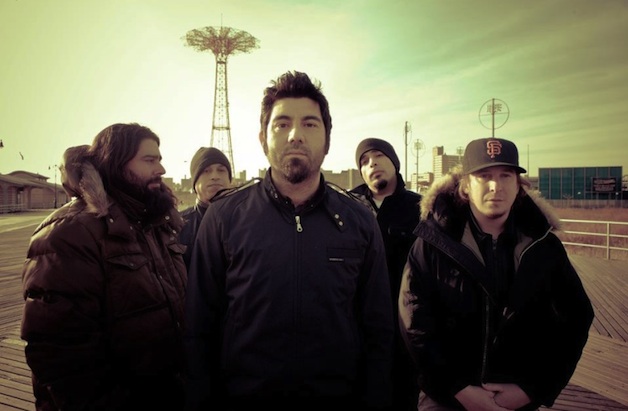
Deftones, 2016
It was nobody’s direct fault, really. Chalk it up to a few naive managerial miscalculations, a reach that extended its financial grasp, or the rapidly changing digital landscape that helped eclipse it. But the rise and fall of Sacramento-based retail giant Tower Records – as told by director Colin Hanks in his meticulous new documentary, All Things Must Pass, is a truly riveting tragedy to behold. Especially in the harsh glare of 20/20 hindsight. Hanks loved the record store, and it shows, in revealing interviews with everyone from charismatic top dog Russ Solomon to rock stars that were once employed there (Foo Fighters firebrand Dave Grohl, for one) or hung there (Sir Elton John, for whom the Hollywood branch opened a full hour early on new release day for his private shopping sprees).
The film goes a long way to recapturing the chain’s ephemeral red-and-yellow-hued magic. But seriously. You really had to work there to understand. It’s true that the Tower wages were never that great. But that wasn’t the big applicant draw. For starters, there was no uniform policy – you could wear any outfit you wanted, and on an average day in an average California location, you could find a long-haired metalhead running the classical music department, a burr-haired skater overseeing vocals, a mohawked punk rocker tending to jazz, and a witch-caped Goth rocker assistant managing the whole deal. No joke. Tower was a magnet for unique individuals, a place where you could really let your freak flag fly. It wasn’t just accepted – it was expected. Then, of course, there was the music.
Essentially, you could play whatever you wanted during your shift, when you had control of the stereo. And everyone took turns. So in a typical three-hour period, Etta James would give way to The Jesus and Mary Chain, which would lead in to Barbara Streisand, then The Pet Shop Boys, Metallica, Marty Robbins, and – gulp – Rick Astley. And you wound up hearing Rick Astley so much. You really came to appreciate his huge dance-floor hooks and picture-perfect Stock-Aitken-Waterman production sheen. That was the best part about punching the Tower clock – you learned. Even if you started work there totally averse to, say, backwoods Carter Family country or raspy Leonard Cohen folk, you’d wind up loving – or at least respecting – it by the time your tour of duty was done. And the friends you made there before you left? Inevitably, most of them would be your friends for life.
Chino Moreno knows all of these intangible wonders. Almost instinctively. The Deftones bandleader hails from Sacramento, where Tower opened its first hippie-era store. Naturally, like a lot of rockers over the years, he worked for Tower, too, at its warehouse there for over a year, back in ’93, ’94. (Full disclosure: This writer also worked for Tower, first for its free entertainment magazine Pulse, then as a rock buyer for two years at a San Francisco location, and yes, the whole experience was awesome. None too profitable, but awesome just the same.) And it left a mark on the man that can still be heard in Deftones music today, as on the adventurous new Gore album, its eighth, which opens on a prog-rock-ish note with “Prayers/Triangles,” then segues into the Brontosaurus stomp of “Acid Hologram,” a classic thrasher “Doomed User,” the jarringly-dissonant “Geometric Headdress,” a jazz-pop experiment called “Xenon,” and ticking time bomb of a power ballad, “Phantom Bride.” The record is co-produced by the band and Matt Hyde, and mixed by Hyde, as well. But it’s definitely a whole new panorama for the expansive, risk-taking vision of Moreno and company (bassist Sergio Vega, drummer Abe Cunningham, keyboardist Frank Delgado, and guitarist Stephen Carpenter).
Does Moreno owe all of this to Tower? Could very well be, he chuckles. “I worked there up until the day we signed our record deal, pretty much,” recalls the vocalist, who has yet to see All Things Must Pass but reckons he’ll come across some old hometown chums in the footage. “And when I quit, from that point, Tower was my last real job, the last job that I had before I had to really start touring. And it was actually one of the best jobs I’ve ever had, aside from being someone who’s making music for a living.” In some ways, he’s sad that he never got to work the cash register – and commandeer the stereo – at a retail outlet. His warehouse purview was magazines, and he had a certain quota that had to be shipped out every week by Friday. And – as any Tower veteran will tell you (and the film makes cocktail-swilling clear) – on Friday, the rule of the house is: Anything goes.
“During the week, we were kind of on our own schedule, so we spent a lot of time reading rock magazines, or any kind of magazine, really,” Moreno says, wistfully. “We got NME, Melody Maker, all these periodicals that I’d never seen before. And this was pre-Internet, so I gained a lot of music knowledge, and it came from reading all these magazines from all over the world. And it was totally lax. On Fridays, our boss would come in and order these little micro-cubes of beer from a place called Rubicon in Sacramento (and Gore closes with a track dubbed “Rubicon”). They were little square mini-kegs of beer, so Fridays we would just sit and have parties. As soon as we were done with our quota that we were supposed to fill? The rest of the day would be spent drinking beer, talking shit, and reading more magazines.” He pauses, remembering those glory days, difficult to describe to any outsiders. “It was a nice environment, for sure.”
Mention the music he heard during his stint and Moreno really gets mushy. Records he might not have been exposed to otherwise. “Honestly,” he sighs. “Some of the best music of my life I was listening to there at Tower. Like P.J. Harvey’s first album, and Nirvana – I was working there when Kurt Cobain died. And all the people that worked there were in bands, or in music somehow, and we just spent a lot of time, sitting around bullshitting and talking about music, and researching and comparing stories.” Naturally, he met the legendary Russ Solomon many times. And he understood how such an affable but irascible businessman could parlay his one unassuming branch into a chain with locations in London, Japan, even South America. In fact, Moreno recently bumped into Solomon for the umpteenth time, at the home of his longtime Sacramento editor/publisher pal Sonny Mayugba (of Heckler Magazine renown); Moreno’s son’s band was playing Mayugba’s daughter’s birthday party. “Russ was there and he was telling me great stories about how cool it was to see everybody from back in the day, all together again,” he says.
The lessons Moreno (who turns 43 this month) learned at Tower have stayed with him over the years. When he formed Deftones with some high school chums (including original bassist Chi Cheng, who passed away in 2013, after a 2008 car accident left him in a minimally conscious state), it was at the height of the nu-metal movement. But they – along with more far-sighted peers like Korn – had bigger sonic fish to fry, and its jagged Maverick Records debut Adrenaline quickly went platinum after its 1995 release. The group hit a new level of creativity with its third sung/snarled White Pony LP in 2000, which featured guests like Scott Weiland, Tool’s Maynard James Keenan, and programmer DJ Crook (who would later form the side project Team Sleep with Moreno). The disc debuted at a lofty #3 on the Billboard charts. “But for me, I never once placed myself in a position where I decided that ‘This is what type of music that I like, and I only like this type of music, and I shut myself to anything else besides that.’” He snorts derisively. He’s always been that open-minded, he adds. “But definitely in high school, when things became very clique-y and you start to choose what type of person you want to be, I never made that choice.
“I’d hang out with the preppie kids on the weekend, sometimes, and go to their catered parties,” he adds. Why? “Hey – there were girls there, you know what I mean? And there was no rule that said that just because I was into metal music, that I couldn’t hang out with these people. So I’d hang out with some of the Goth kids sometimes on the weekend and go to their dance clubs, and I skateboarded all the time, so I had all these different friends and all these so-called cliques of people, and I never felt weird about it. It always felt really natural to me. Like, ‘Why would I put myself in some box and say that this is where I am? So musically, I’ve always been in that same headspace. And I feel like everybody in the band is the same way – ever since we started making music, we’re always striving to find something new to turn one another onto.”
The rocker no longer has to wait for a co-worker to spin something revelatory during his shift. Nowadays, he has the Internet. So he has a new morning ritual that’s one of his favorites – he wakes up, logs on, and begins searching. Scouring for great new music that catches his ear. Or his eye, if he stumbles across a particularly inviting YouTube clip. And then? He promptly forwards what he’s discovered to his bandmates and close friends. Or any acquaintance that he believes might benefit from said information. “Sharing things back and forth? In the Tower days, it was always word of mouth,” he says. “Now we have cellphones and the technology for you to do it on a bigger scale – just talking and sharing, you know?”
Moreno’s influences gradually expanded to include Helmet, Weezer, The Cure, The Smiths, Smashing Pumpkins, The Bad Brains, Cocteau Twins, even Duran Duran and Depeche Mode. That’s the kind of varied palate that only record retail gigs can teach you. What was he spinning for Gore? He stops for a second, unsure. “That’s a really hard question, because I don’t think I was listening to any one thing in particular,” he admits. “Nothing that really guided me in that direction. But honestly, any time we make a record, I feel like I should always be trying to push myself in one way or another. But I feel that there’s still a part of me that tries to maintain what we’ve created. I’m not trying reinvent ourselves, is what I’m trying to say.
“But at the same time, I’m trying to expand on what we’ve done in the past,” he continues. “So any time something sounds a little too formulaic, my general instinct is to turn either to the left or to the right, and try a different direction. And that stuff kind of happens organically, as well, especially when you’re working with people that you’ve been making records with forever, and everybody kind of has that mindset. And because we’ve been friends for so long, we call each other out, as well. People in the band aren’t afraid to speak up and say, ‘Hey – that sounds boring,’ or ‘I really don’t like that’ or whatever. And the fact that we have that kind of relationship? I think that’s what keeps us on our toes, to some extent.”
Moreno’s ears are also keenly trained to pick up on a good musical idea when he hears it. And that’s why Gore doesn’t sound anything like Deftones’ last set, 2012’s Koi No Yokan. And he was aware of the difference during the writing process. He was working on the verses to the space-y “Prayers/Triangles” (and thought-provoking lyrics like “There’s a new strange godless demon awake inside me… Prayers laid on the line, you will never be free/ Triangles placed in your mind, you will never be free/ I’d beware”) when Carpenter walked into the studio and immediately began playing what would become the chord progressions of the chorus. “And the way he was playing it, I thought, ‘Well, that kind of sounds like U2 or something! The way it starts on the snare and pops in, in double time.’ But this was something that just happened naturally, and it came from Stephen, and he’s the most metal dude I know! So he wrote something that wasn’t metal, and it felt really comfortable. So at that point, I didn’t really second-guess it. It didn’t really sound like us. But to me, it was exactly who we were in that moment. It happened organically, and those kinds of moments are what we live for.”
What does the album title signify, if anything? Sorry to disappoint eager fans, but he’s just not a horror-flick fan, Moreno confesses. He prefers classic film noir instead. He just liked the way it looked juxtaposed on the CD cover, over a photograph of flying flamingos. “And to me, that’s a good indication of not only what Gore is about, but kind of what our band is about, too,” he explains. “Those highs and lows, and the dynamics and dichotomy of our sound, in general. Besides, you’ve got to pick something for a title, and I think that works. That was exactly where we were at.”
But where would Moreno be if he didn’t have his Deftones? Or other spinoff outfits like Palms and Crosses? He gets that question a lot, he says, laughing. “People always ask me, ‘What would you be doing if you weren’t in a rock band?’ And I always say, ‘Working in a record store!’” he concludes, a Tower man forever, like everyone who was lucky enough to be enraptured by its delectable deep. “And it’s sad, I know. And it’s not much of a career. But honestly? It’s one of the funnest jobs that I ever had!”
-Tom Lanham
Appearing 9/16/16, Riot Fest, Chicago. Tickets available HERE