Hello My Name Is…Martin Rossiter of Gene

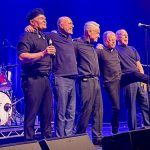
Martin Rossiter (front) of Gene (Photo by Jim Mitcham)
With an elegant, multifaceted sound and themes that swung grandly between sweet, sharp, witty, romantic, and melancholy, Gene gathered a devoted cult of British rock fans from the mid-90s to the early 2000s. Martin Rossiter’s poetic lyricism and sweeping melodies formed the band’s musical foundation, with guitarist Steve Mason, bassist Kevin Miles, and drummer Matt James rounding out the lineup. Gene shed early comparisons to the Smiths, crafting a unique musical universe that drew as much from American soul and pop as from influential UK bands like the Faces and the Jam. Despite missing the US Billboard charts, Gene landed 10 songs in the UK Top 40, including the wry debut single “For the Dead,” the titanic “Olympian,” the adrenalized “Fighting Fit,” and the swaggering “Haunted by You.”
After disbanding in 2004, Gene reunited in 2025 to perform shows in the UK culminating in this year’s live album Apollo. The group is now readying its first North American shows in 22 years. The tour stops at Chicago’s Bottom Lounge on November 16. Rossiter spoke with IE from home in Brighton shortly after two sold-out concerts in October at London’s Roundhouse.
IE: After several reunion shows featuring the vintage Gene catalog, you introduced new material at the Roundhouse. I was lucky to be there. Were you proving something to yourselves or to your audience? Should fans hope for more?
MARTIN ROSSITER: I think we’re trying to prove something to each other, which matters. I do feel like we’re having to push the boulder with less force now. It feels like there’s a little bit of momentum growing. We haven’t committed to anything. We’ve just said, “Let’s see what happens.”
IE: That suggests that there’s no plan for an album, but it’s not out of the question.
MR: That’s probably the best way of putting it. If we get to the point where we have six or seven songs we’re happy with, then it becomes more likely. After the States, we’re not playing again until March. So, we’ll probably get together a few times and see if the proverbial juices bubble up and flow.
IE: For many years, it had to seem impossible that Gene would ever play together again. Now it’s perhaps an indefinite thing.
MR: Well, death comes to us all.
IE: Okay, not wholly indefinite.
MR: I’m the youngest, but I’ll probably be the first to go. If I were a betting man, though, I think we’re going to write another 10 or 11 really great songs.
IE: You once spoke of your internal “Mick Jagger alarm” that would tell you when it was time for Gene to stop and avoid becoming a nostalgia act. There’s obviously been really joyful nostalgia from fans in seeing Gene again.
MR: I think everybody knows what nostalgia feels like, almost physically. I’m not sure I can describe it, but it’s a little bit like the difference between Michelangelo’s David and porn. You can’t quite say what the difference is, but you know it when you see it.
When we went on stage at the Brudenell Social Club in Leeds [last year for Gene’s first concert in 21 years], it was the first of our two warmups for the [Hammersmith] Apollo show. It didn’t feel nostalgic. It felt vital. It felt fairly youthful. Although by no means a majority, at a lot of the shows, maybe five percent of the crowd are young. That helps.
If we just sort of carried on [playing concerts] for another couple of years and not writing, then yes, [the alarm] might have started. Whatever that feeling is, I think I would have started to feel it.
IE: But the Jagger alarm hasn’t rung?
MR: No, it hasn’t even tinkled.
IE: How surprised does that make you, looking back on some of those things you might have said around the time that the band split?
MR: I’m often wrong, to be honest. I pride myself on getting things wrong [laughs].
IE: But happy to be so?
MR: Yes, happy to be wrong. When we went into rehearsal, we had several moments where we would be playing “Your Love, It Lies” or “You’ll Never Walk Again” or whichever song. They didn’t feel like they’d become dated, which is really important. We were all glancing at each other. You could see in people’s faces this feeling of, “God, this is really quite good, isn’t it?”
The only element of all we’ve done in this second iteration of the band that’s made me feel nostalgic is writing the [new] songs. It does throw me back to being sat on my bedroom floor at my mum’s house before I could even afford to move out of home. A couple of months ago, I ceremoniously went to a small independent bookshop here in Brighton and chose a notebook that I was going to use. That was quite a symbolic moment for me because I used to do that with every album.
IE: Debuting songs in London implied that creative work factors into making Gene’s reunion satisfying for yourselves. How new is “Tristan?”
MR: About as new as you can get. We were able to rehearse it because I had enough sort of melodic shapes for each section. It was a little bit like “Yesterday,” when Paul McCartney originally wrote “Scrambled Eggs.” Sometimes you have placeholder lyrics. That allowed us to knock it about over the space of three or four different rehearsals. But the words weren’t finished until a few days before the show. There’s [nothing] like a deadline, I tell ya.
IE: The song’s premise involves the Tate brothers. Was it sparked by recent news, or something more general?
MR: They’re obviously objectionable human beings, and I don’t think that’s a particularly controversial thing to say. But Tristan is somehow even slightly more pathetic than his brother [Andrew]. He’s trying to be this Bugatti-driving, cigar-smoking, sexually abusing bad boy, and he’s not even the best at that in his family. For me, he cuts a deeply pathetic figure. I thought that was quite an interesting angle to write about.
IE: It seemed like it was about being in the shadow of something that’s not really worth aspiring to.
MR: You’ve put it better than I did. There is one line [comparing the younger Tate to] “a nodding toy dog in the back of a Ford Mondeo.”
IE: You’ve had “Rain Makes the Roses Grow” a while longer, correct?
MR: I wrote that about five or six years ago. Believe it or not, I was asked to write a song for Simply Red. What I’d noticed is that they had done two Cole Porter covers – “If You Don’t Know My by Now,” and I can’t remember the other one. So, I tried to write a Cole Porter song with the language of the era. It’s using loads of weather analogies and then has the chorus of, “sit back, baby, I’ve good news to unveil.” [Simply Red] didn’t use the song, so their loss is our blessing, I guess.
IE: The tone and sentiment reminded me of “Little Child,” written for your first daughter. Was this song also very personal?
MR: I’ll be honest, no. I think it’s okay to be biographical in songs, but I haven’t lived enough lives to write six albums’ worth of autobiographical songs. It’s a simple notion of somebody reassuring somebody else that sometimes good things can come from bad things. It’s not like me to be hopeful, but I can occasionally muster a little.
IE: Will you play another new song in Chicago?
MR: There’s one on the way, but I don’t know if it’ll be ready in time. It depends how drunk I get tonight.
IE: This will be your first time performing in Chicago in 24 years, and perhaps the first run of shows that you’d consider an actual tour in decades. Are you eager for it?
MR: I’m loathe to play the woe-is-me musician, because that’s terribly dull. I’ve been lucky for at least some of my life to earn my living from waggling my fat ass on stage. I love playing live. But it almost gives you the tiniest glimmer, like a peephole in a door, into what it’s like to be a despot. Even if it’s 300 people in Chicago or 5000 people in London, there’s something deeply unhealthy about having a huge number of people respond to everything you do. It does something to the brain.
IE: Speaking of despots, you’re coming to North America at a potent time. You’ll be here in the aftermath of the midterms. Will you avoid or gleefully engage in conversations about that?
MR: I’ll gleefully engage with them, I think. I’ve never been able to keep my mouth shut as it is. We’re not what you would call a political band. I love Kneecap, but we’re not that. We’re not Public Enemy. However, I’ve never been one to shy away from talking about politics. I don’t hide that I’m left-wing. I make Bernie Sanders look like Mussolini … well, that’s a bit unfair on Bernie.
IE: It struck me that everyone at the Roundhouse was singing along to lines like “the greedy live off you and me” that “As Good as It Gets” is shockingly of the moment, maybe more than it was in 1999.
MR: I was thinking about that while I was singing it, believe it or not. Quite a few of the songs have been apropos. There’s a line in “Mayday,” “We’re guilty as charged, let Mandelson infiltrate.” Lo and behold, 25 years later, [influential Labour Party figure] Peter Mandelson’s in the Epstein files.
We had a song called “Welcome to Dover,” which was about immigration. In the UK, we had an incident [in September] where somebody’s now in prison awaiting trial because he went out into the English Channel with a knife and tried to stab a boat that was there to rescue migrants crossing the water. And we’ve got [his associate] Tommy Robinson, who’s on trial at the moment and might be going to prison. His legal costs are being funded by Elon Musk – who, by the way, was [allegedly] an illegal immigrant.
IE: The irony is thick.
MR: I’m sure that melanin doesn’t come into it at all, he says, with appropriate British sarcasm.
IE: Gene eventually overcame critical Smiths comparisons. One connection I felt was fair was your penchant for addressing heavy topics with humor or sarcasm. I think of “For the Dead” as a bleak song, but wit’s involved.
MR: It’s an especially British tradition and part of our way of communicating that we minimize. If something’s amazing, we say, “Oh, that’s not half bad, is it?” Or if something terrible is happening, we say, “We might have a little problem.” This is unlike the Americans. You and the Dutch and the Swedes are very straightforward in how you talk, and we’re terribly, terribly coded. That use of humor to describe the darkest times is really the only way I have, and I think the British have, of doing it.
IE: Even though it was still reductive, it seemed like a positive step when people began comparing Gene to the Jam and the Faces, too. That still omitted a lot of your musical DNA.
MR: Soul music as well. Motown, reggae …
IE: Am I wrong to hear any Simon & Garfunkel at the root of “I Can’t Help Myself,” maybe as the song existed before it came to the band?
MR: I do love, love Simon & Garfunkel. They’re part of our DNA. Certainly, they’ve helped shape some of the melodic choices that I make through osmosis, probably just from listening to them a lot. I can also remember Steve coming in with a guitar part that he said he’d ripped off from [“The 59th Street Bridge Song] (Feeling Groovy”).
IE: So, it’s not just you.
MR: No, it’s not just me. Kev’s a massive fan as well. The quality of Paul Simon’s songwriting is absolutely astonishing.

Photo by Jeff Elbel
IE: With four people involved, your influences can’t be reduced to one band or even three. Can you name another source that would surprise people?
MR: Once, when I was in my 20s, we had a piano at home, and I was just writing this piece of music for the sake of writing a piece of music. I played it to my mum, and she quoted which hymn I had subconsciously ripped off. There’s some interesting research showing that our emotional responses to music become hardwired about the age of 12. So, if you grow up listening to Indonesian music in Indonesia, what might sound to Western ears like something quite somber could be perceived as celebratory over there.
Those basic emotional responses to rhythmic, melodic, and harmonic [sounds] are pretty much hardwired, and mine come from church. Not in a gospel way, because we don’t really have many gospel churches in the UK, but from a Methodist church in Cardiff and all those great hymns and Christmas carols.
Those are the things that have shaped me when I think about melody. So, onto the Faces and the Smiths and soul and reggae and Simon & Garfunkel, you can add 10%, John Wesley.
IE: I can imagine some of those hymnal melodies informing “I Can’t Help Myself,” now that you mention it.
MR: Yeah, and even things like the soaring descant parts of “O Come, All Ye Faithful” and pieces of music like that. What you have to remember with hymns is that they’ve gone through the organic process of generation after generation of people saying, “Yes, we will continue singing those hymns in our churches.” By the time I was going to Methodist Chapel in Cardiff when I was five, six, seven, eight, nine, 120 years of people had deemed that this was the best of the best. Those melodies astonish me still to this day.
IE: “For the Dead” is an early song that you wrote when you were still living in Watford with your mum?
MR: Yes. “For the Dead” was the first song where I think we all realized we could do it. It may have been about the eighth song that we’d written collectively.
Steve was still at university, and he had a little flat down in Kingston upon Thames, which is southwest London. We used to jump on the train, and we’d record on his four-track Tascam recorder. Normally, we would program a basic Yamaha drum machine, and we’d make these little demos at Steve’s house. We demoed “For the Dead,” and I remember it had a little glitch halfway through the second verse, but we were very excited about it.
Steve and I got on the train to Fulham and went to our manager’s office. Our manager at the time was also a press officer. We were like, “Jerry [Smith], Jerry, you’ve got to listen to this!” We played it really loud in his office, and we both coughed when the glitch happened.
There were two journalists outside who were waiting to interview the Tindersticks, if I remember rightly. That was Keith Cameron and Roy Wilkinson, who started the [Costermonger] record company. So, they heard this song through the door, and then these two sort of young, slightly cocky lads walked out. They were like, what is this? Who is this band? That’s how it all started.
So, it was “For the Dead” that did it.
IE: How different is it to sing “London, Can You Wait” in Chicago than among hometown friends in London itself?
MR: I don’t think it makes any difference. Obviously, we won’t be playing to as many people. But it’s quite interesting. When we talked about songwriting and how not every song can be autobiographical, that was one of the first songs I wrote that wasn’t autobiographical.
I remember words running a little bit dry at the time and thinking, “If nothing’s popping into your head from your own life, just invent a situation.” For “London, Can You Wait,” I imagined I had a brother who killed himself when nobody saw it coming. Looking back at this fictional brother’s life, that line “London, can you wait for all the things I’ve got to say?” is a piece of dialogue he said. Therefore, the family is thinking that everything was hopeful, and this brother had a future when he didn’t. I think it applies in Kuala Lumpur as much as it does in Mogadishu.
IE: At the Roundhouse, you mentioned dreaming that “Somewhere in the World” was something that Elvis Presley could sing. I imagine something in the vein of “In the Ghetto.”
MR: That would be lovely. You find that certain writers develop their own lexicon or choices of words that are common to them. Brett Anderson [of Suede] certainly has it. The number of times he mentions concrete and asphalt is phenomenal. He created his own world. Bowie created his. To a degree, I did the same. Without wanting to sound too pompous, so forgive me, “Somewhere in the World” felt like a song that could be in the Great American Songbook. It’s got a quite traditional quality to it. It feels lyrically and melodically universal, I think.
IE: If you could take an Elvis song as your own, what would it be?
MR: “If I Can Dream.” I love a lot of Elvis, but I quite like the sort of bombastic late 60s, early 70s songs when the waistline’s growing, as is the musical ambition.
IE: You could probably rent a jumpsuit while you’re in the States.
MR: I will definitely do that. Head to toe in rhinestones!
Appearing at Bottom Lounge, Chicago on November 16.
-Jeff Elbel




Category: Featured, Hello My Name Is