Cover Story: Gogol Bordello • Slava Riot Fest
Gogol Bordello
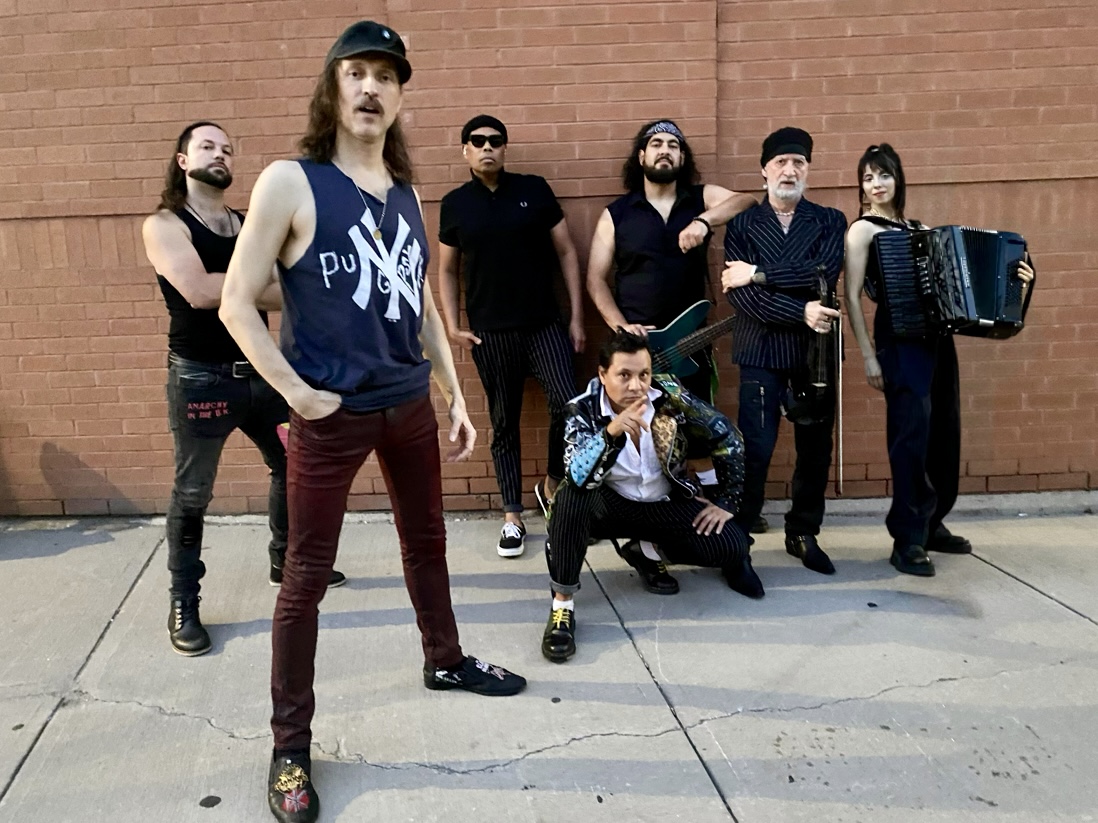
New York gypsy punk band Gogol Bordello has always followed their own frequency. Never concerned with industry trends or appealing to the masses, the band has done whatever the hell they want for nearly 30 years. And it works. Not only have they carved out their own little niche, but their eclectic music has also been featured in numerous films; they’ve toured all over the world and have shared the stage with the likes of Flogging Molly, Cake, and System of a Down.
For frontman Eugene Hütz, Gogol Bordello isn’t just a band. It’s a community. A support system that gives him full freedom of expression, whether that’s with the band or with one of his other musical outputs. He uses that sense of community to help up-and-coming artists on his new label Casa Gogol Records. More importantly, the band embraces Hütz’s unique frequency that continues to drive the uncompromising nature of Gogol Bordello.
Before embarking on their European tour, Hütz chatted with IE to talk about his journey from Kyiv to New York, his upcoming book, his love of Riot Fest, and the spirit that keeps Gogol Bordello alive.
Illinois Entertainer: Gogol Bordello released a new album, **We Mean It Man!**, earlier this year, and sonically, it’s an attempt to reconnect with the post-punk influences central to the band’s origins. What was it like to dig in and reconnect with those roots to highlight them on this new album?
Eugene Hütz: The previous album, **Solidaritine, was a very pure punk hardcore album produced by Walter Schreifels of Gorilla Biscuits, Youth of Today, and Quicksand. This album was more post-punk, drony, techno punk with lots of synths layered in, which makes what you said partly true because we do have a lot of influences. With eight members [in the band], the influences are vast. Even in my own trajectory, what I originally brought to the band was undetected by them for a long time.
We all met in New York around 2000, and the band kind of snowballed into this operation with a lot of people, but they had no idea I was coming out of a decade of making electronic and industrial music and playing in hardcore bands and some psychobilly experiments and spending a lot of time in theater with performance art. Things started to evolve when we were on tour, and I would go to some rave or hardcore show afterward. Then Pedro [Erazo], who’s been in the band with me for over 15 years, would go, “It’s interesting how you got into hardcore recently.” Yeah, it’s so interesting, except for the fact that I spent the entire ’90s in a mosh pit as a teenager. Or Sergio [Ryabtsev] would say, “It’s so interesting how you got into electronic music lately.” Yeah, it’s so interesting because I still have my stack of synthesizers in my storage space, which I put in there as soon as I met you because I wanted a clean slate (laughs).
So, this album connected the dots of all those super vital influences. Even though we’re perceived as such a singular band that went out on this limb and did everything our own way, it would be an exaggeration to say we didn’t grow up listening to The Cure and Siouxsie and the Banshees like everybody else. Post-punk was the most accessible and fun artistic playground for so many of us. I wasn’t there when the original punk [movement] was happening, so it wouldn’t be inaccurate to say our playground was essentially post-punk, with streaks of post-hardcore and all kinds of electronic incarnations of punk. This album connected all of that, as you can tell right on the first song [“We Mean It, Man!”]. It’s like techno hardcore for the people who like gypsy punk.
IE: It works, and you can hear all those influences. I’m a huge fan of The Cure, and I heard traces of them and New Order, which makes sense since Bernard Sumner is on the record.
EH: It’s funny, we actually call [“Solidarity”] “Blue and Yellow Monday” amongst ourselves because it’s a dedication to Ukraine.
IE: I’m a sucker for synth, and it’s all great on the album, but what really stuck out to me is how most of the songs are about people coming together. That feels very important now because we’re at a time when the powers that be are trying to push people apart and promote an us-versus-them mentality, when we need to come together not only to support each other but to push back. When it came time to make the record, did you go into it knowing that this is one of the themes you wanted to tackle?
EH: It’s a more extreme form of it, but those topics are always there. I don’t think we have one album where we didn’t do that in terms of conjuring up some kind of bonfire for everyone who is willing to chime in with the goodwill to dance around. It’s a natural state of being for me and for us as a band. That’s always our theme; even as a band, we have that mentality. Of course, we have our own separate lives and individual tastes, but when we go on tour, it becomes one beast. There’s a lot of shared culture, and it’s really unifying and fun. As simple as it sounds, it’s just better to live that way than going out on some kind of misanthropic, egomaniacal notion that you’re the chosen one with some kind of fucking apocalyptic message. Personally, I don’t really care about that kind of stuff anymore. When you’re young, you can often misread that kind of pursuit as something really inspiring or something that promotes the spirit of individuality, but over time, if that character doesn’t become a servant to the community of one kind or another, that trajectory is basically futile and loses its mission. I think the individual is important as long as it propels the community in a positive direction.
IE: That sense of community feels central to what Gogol Bordello does, like your shows, your songs, and your new label, Casa Gogol Records. It feels like it all goes back to community, which is a really beautiful thing, especially during a time when we need community more than ever.
EH: Yeah, it’s about falling in love with what your friends do and what they have to offer. Then you don’t need to create community; it’s already created. It’s a self-evolving thing. If you pull your head out of your ass and actually give time to see what other people are doing, you may find there are more sources of joy and talent around you than you think. Right now, it takes a bit of effort to do because there’s a lot of fatigue from overstimulation and oversaturation. People kind of shut off a lot of that or pursue it on a very superficial level, but the advantage of being from my generation is that we were not saturated. My mind is trained to actively seek out content and talent because back then there was a severe lack of information. You went out to shows that were God knows where, in a different state or different country. You got in touch with people through fanzines and the mail. When others talk about fatigue and oversaturation, I find they’re overstimulated and oversaturated with fountains of mediocrity and not really zooming in on other good stuff that’s directly around them. Like, all my favorite music that I found now, I found through artists who are on my label.
IE: Let’s talk about the new label, Casa Gogol Records. That’s where you released your new album. What inspired you to launch your record label now?
EH: Living in New York is a transit point for a lot of charged people; there’s a lot of spark going on, so starting a label was a natural thing to do during a time when all my friends who have successful labels said, “Don’t do it! Now’s not the time!” (laughs). Now that [the label’s] going, I think we should have done it earlier. You find an artist you really admire, start working with them, get more into their bubble, and like it even more. Then it’s exciting to get their name out there because you’re kind of one being with them at that point. That’s kind of how we operate. Even now, as soon as I get off this call, we’re going to participate in a video of one of our artists, an electric punk band called Pons –very charged up, super eccentric, super fun. Me, Victoria [Espinoza], and Kay [Bontempo] from Puzzled Panther, another band on the label, are going to shoot a video with them. We all just came back from a mini-European tour where Pons, Puzzle Panther, and I had a streak of DJ dates and played festivals as part of a supergroup we put together. It’s not only a community, but it’s a community with a distinct lifestyle that has its own rhythm and keeps on rolling, kind of like what would happen if you ran away with a Gypsy circus.
IE: So along with all this great stuff you got going on this year, you also have a book on the way, Lost Innocent World, which comes out in December. When did you start working on the book?
EH: You know, I wish I’d started it earlier. A publisher asked me to write about the journey of Gogol Bordello 15 years ago, and I said, “What, am I a soccer player?” By the time you’re 33, you already need to rewrite a book? I needed to take a couple more turns in life. The story needed to ripen a little bit more. I was delaying it until I read two books that really inspired me. One of them was Roger Miret of Agnostic Front’s My Riot – he’s always been a huge inspiration for me. The other was Thurston Moore of Sonic Youth’s Sonic Life: A Memoir. He’s a very important, life-changing character from a life-changing band for me. I saw Sonic Youth back in 1989 in Ukraine, which made me want to move to New York, so that was the beginning of the story right there.
[My book] cannot be viewed as the complete story of Gogol Bordello. I crafted it in a way that’s more like an action novel because I hate the idea of a memoir. It just sounds so tedious; of course, it depends on whose memoir it is, but the idea of the prodigal son has been around the block for a while. That’s not the story I wanted to tell. I wanted to tell a story about another way of life that’s possible if you don’t settle for what they tell you to do and kind of go out on a limb without any plan B. I never had any kind of plan B. American pragmatism teaches you to have a plan B and a plan C. There’s something to be said about that, but energetically, it dilutes your mission because you are seeing yourself as a fractured being who is doing this but could also be doing that, but should be doing this, but your parents want you to do that, while society thinks you actually should be doing this. That takes away people’s power and energy to the point where they live their lives in a futile way and reach a point where it’s too late to start anew. For me, the music I think of as punk rock is driven by that notion. Those are the spiritual pioneers of self-actualization, so I wanted to tell the story of how you can get on some seemingly obscure frequency. If you are a diligent co-propeller of that frequency, it will guide you exactly where you want to be. That requires a little bit of so-called magical thinking to follow through with, but it’s there for you.
If you’ve got a particular frequency that embraces you, embrace it. If it has a positive vibe, go with it no matter what. Your parents and society become irrelevant in terms of what they think about it, because it’s not their frequency, so the book is largely about that. It’s about pursuing that frequency. It’s a very unpragmatic book. It has a lot more to do with connecting with people and falling in love with what other people are doing and living in that world.
IE: Growing up in American culture, we are hammered with the message of having a plan B. Even if you want to be an artist or a musician, the first thing you’re told is to have a backup plan. Now, we’re at the point where it feels like the message of following your passion is lost.
EH: Yeah, it’s lost. It’s all about being practical, making money, surviving. Sure, but you should still be pursuing your passions. There is no other way to so-called happiness. Happiness is a pretty corny word, but there’s no other way to self-fulfillment or feeling whole because if you’re living fractured, you’re going to feel fractured. Now, the message is not only lost, but it’s also bulldozed over with another message: be a follower. Have no personality, be uniform. And people don’t even notice how they’ve already completely lost their way. Only a few years back, people who were into punk rock would also be into Noam Chomsky or read intellectual literature about how content is manufactured for the masses and how the masses are easily manipulated. Now it’s just like, be manipulated, be with the masses, be with the followers, get more followers, be dumb. Then you’ll go to some commercial, mass-marketed punk festival, and it’s all about that. For those who have eyes to see and still have some kind of defiance living within them, this is the time to strengthen that muscle.
IE: As you said, the book isn’t just about the history of Gogol Bordello; it’s also about your own musical journey, which starts in Ukraine. Tell me more about that.
EH: Well, the book starts in Kyiv, where my father handed me his guitar. I kind of took after my dad, who was an underground musician there. I wanted to capture the atmosphere of Kyiv’s magical, deep underground scene, with the bands that were prominent at the time, including my own band. That’s where my story begins. Then I arrived here on the East Coast and was swept off my feet by the New York hardcore scene, which became my new home. Looking back, it’s amazing to see how my trajectory was just going from one pocket of some new, crazy ass music that’s happening into another and another. I just went where the most action was. New York is very good about that because awesome music originates here. Let’s not make any mistakes about it. Sure, other places have their own accomplishments, especially Chicago with Wax Trax and Steve Albini, and the Seattle scene in D.C., and there’s respective regional scenes that have impact. But in New York, you can pretty much come in with the most seemingly marginal message, but if it has unifying power and serves the community in a certain positive sense, the city will embrace it and actually push it along and help you.
As somebody who’s been in New York for a long time, I’ve always observed how something gets initiated here and then blows up elsewhere. Another well-known phenomenon is how bands from New York go to the UK, blow up there, and then return here as heroes, including Gogol Bordello. We started playing in clubs for 300 people until we went to London, then returned here. After that, we played in clubs for1500 people. A lot of the book is New York-centric in that sense. It always traces back to New York, even the birth of so-called gypsy punk. I describe it in a very documentary-like way in the book: the whole genesis of that idea and how it wasn’t mine. It was a synergetic idea of actual Romani gypsy people coming to see Gogol Bordello out of curiosity and saying, it’s like gypsy punk. You need to drive this home. You need to make our people proud. Here is the torch. Go do it. So [the book] is like a love letter to New York City and what it can do for you.
IE: Speaking of Chicago, you guys are coming here for Riot Fest. You’re no stranger to Riot Fest as you’ve performed there many times. What about Riot Fest that resonates with you where you keep coming back for more?
EH: I think it’s the modernity of it, in terms of its all-encompassing curation, which is a complicated thing to do. To present punk as movements and as a movement that always grows a new tail. You really need to be hands-on with the OGs of punk and the latest of it and everything in the middle and constantly put the Rubik’s Cube together again. That takes a lot of intellectual curiosity and a deep understanding of the roots of this music. Also, being really discerning about getting new names- not just some low-hanging fruit, but getting something legit. Every time I look at the lineup, I see a reflection of that. I know there’s an agonizing amount of thought that goes into that, and it never settles for some kind of formula. In a lot of ways Gogol Bordello is exactly like that, too. You may have seen Gogol Bordello ten times, but I can tell you one thing: you’ve never seen it the same twice because things are always shifting. So, for us, playing Riot Fest reflects our spirit. It’s going to be all those OG fire enzymes, but it’s always going to be rejuvenated. We’re always flattered when Chicago fans talk about starting a petition for Gogol Bordello to play Riot Fest every year. We have a great history with Chicago. We recorded one of our strongest albums, **Gypsy Punks: Underdog World Strike, there with Steve Albini. This year we’re going to have a Casa Gogol late-night show after we play on Saturday. It’s going to be a great way for us to be a part of Riot Fest while launching another streak of punk rock activities from New York City through our DJing, through our global gypsy punk party. We’re looking forward to that.
IE: This year marks the 27th anniversary of Gogo Bordello’s debut album, ***Voi-La Intruder. And here you are, still doing the damn thing. You released a new album, got the record label, and have a book on the way. What keeps you going for over two decades?
EH: I’m a lifer, so I don’t think 20 years is an accomplishment. It’s just what I do. I think what keeps the wheel seamlessly rolling is falling in love with new music. Music really is an underappreciated thing. Of course, everybody loves music, but people love it in a very habitual way. A lot of people don’t really crack into what music is, and they don’t have to. I’m just saying that when you do, it’s like the essence of life. On a deeper level, our lives are guided by music and the atmosphere it brings, and vice versa. Having a label and being deeply immersed in what younger artists are doing is essential to how I view the world. I already know what people from the previous generation are doing. That’s done. It excites my soul to see what the next generation is going to do. I feel more engaged in their process than in following my favorite artists, who have settled into their own style so deeply that it’s a challenge for them to do something different.
We’re all kind of victims of our own invention in a certain sense. Sooner or later, there is a tangible box around you, and you can rattle it and get out of it to some extent. But you’re proud of your box, too. It’s like, hey, listen, this is what I’ve done. The escape from it by closely working with new artists that are doing something drastically different is glorious. As a producer, I find a lot of excitement and joy in doing that. Gogol Bordello is rolling; it’s like a wheel rolling on its own. We’re about to leave on tour for six weeks. Sure, I can do that in my sleep. It’s awesome. It’s amazing. I’m exaggerating, but you know what I’m saying? It’s like I got it. Here’s my ship and I get behind the wheel, and the spectacle ensues.
Gogol Bordello will appear at this year’s Riot Fest in Douglass Park on Saturday, September 19th. You can catch their Casa Gogol Records late-night show with That Handsome Devil at Sleeping Village after their Riot Fest set at 10 PM.
– Ashley Perez-Hollingsworth
Category: Cover Story, Featured