Live Review & Gallery: David Byrne at Auditorium Theatre • Chicago
David Byrne
Auditorium Theatre
October 28, 2025
Chicago, IL
Live review by Jeff Elbel, Live photos by Curt Baran.
Tuesday’s concert by David Byrne began with a recorded welcome from the artist, informing patrons that the Auditorium Theatre management had agreed to allow dancing if the aisles were kept clear. “In the event of a fire, dancers in the aisle have an unfair advantage,” said Byrne’s disembodied voice. The humorous quip was a good indicator of the gregarious tone of the show that followed.
In 2018, the perpetually inventive David Byrne brought his American Utopia concert to Chicago. The presentation was as theatrical as it was musical, and the show went on to a successful Broadway run following the tour. This week’s four-night stand presents an evolved show that celebrates the music of Talking Heads and highlights fan-favorite solo songs including “Like Humans Do.”
Although it’s not the Talking Heads reunion project that some fans dared hope to see when the original four members promoted the restored Stop Making Sense film together in 2023, Byrne declined every high-dollar offer and proceeded to make an album that is wholly true to himself. Who is the Sky?captures the essence of what makes Byrne a beloved artist. Songs like “Everybody Laughs” take bemused and sometimes befuddled but curious looks at human behavior, as if it’s being studied by an alien anthropologist – albeit one that happens to be falling in love with his objects of study. The songs are thoughtful, vulnerable, and sometimes endearingly silly.
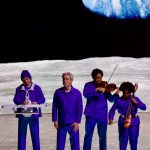
The American Utopia show featured Byrne’s large ensemble on a bare stage surrounded by curtains of chains that reflected colorful lights. For Who is the Sky?, high-definition screens surrounded the band and tiled the floor. Whereas the minimalist adornment of the American Utopia shows encouraged focus on the cast as storytellers, the expanded visuals for Who is the Sky? accentuated the stories and messages within the songs themselves.
The graphics gave the illusion of Bryne, his two string players, and keyboardist standing on the stark landscape of the moon during opening number “Heaven.” Afterward, Byrne pointed to the image of the Earth rising in the blackness of space above the lunar landscape. “There she is, our heaven,” he said. “The only one we have.”
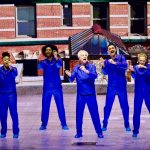
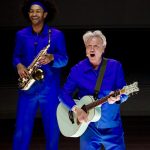
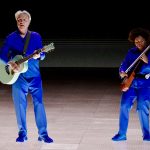
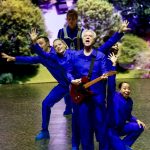
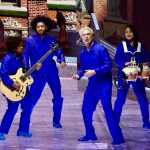
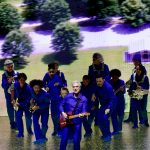
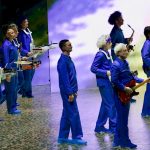
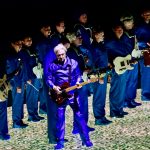
Players appeared in matching gray suits and roamed the stage barefooted for American Utopia. This time, the 13 people onstage traded their barefoot business attire for royal blue work clothes and matching shoes.
The thoroughly choreographed show untethered the artists from “traditional rock band” stations onstage and had them roaming together as a reinvented marching band. The drum set was dismantled and distributed over the shoulders of four players, including returning percussionist and music director Mauro Refosco. Refosco has worked with other famous rockers including Stewart Copeland of the Police and Thom Yorke of Radiohead.
The group included six dedicated musicians and five dancers/singers. Jordan Dobson was an additional member who served multiple roles as singer, dancer, and saxophonist, but the whole cast were necessarily versatile. The movements were individually simple, but the collective organization was highly complex considering the constant motion and interaction.
Five songs from Who is the Sky? were introduced during the 105-minute performance.
Byrne prefaced new song “What is the Reason for It?” by paraphrasing actor, director, and visiting University of Michigan professor John Cameron Mitchell. “He said that love and kindness are the most punk things you can do right now,” said Byrne. The singer admitted that he initially didn’t get Mitchell’s point. “Then I realized, yeah,” said Byrne. “Love and kindness – they’re a form of resistance.” The song itself questioned the purpose and nature of love. Dancer/singer Tendayi Kuumba, another returning member of the American Utopia cast, was featured in duet with Byrne.
Diversions from Byrne’s solo and Talking Heads catalogs included the harmony-rich and effervescent “Strange Overtones” from 2008’s Everything That Happens Will Happen Today, Byrne’s second collaborative album with Brian Eno. Paramore’s “Hard Times” was covered.
Also performed was the as-yet-unreleased “T-shirt.” “My beliefs are on this T-shirt,” sang Byrne as the song began. A later lyric stated, “Every single cliched word is true.” On screen behind the band, a string of zingers and platitudes streamed. “Sorry I’m late, I didn’t want to come,” “Best Dad Ever,” “Well behaved women rarely make history,” “Life’s a beach,” and “We’re all dogs in God’s hot car” were a handful of examples. “No kings” and “Chicago kicks ass” drew loud cheers from the crowd.
Setting up “Moisturizing Thing,” Byrne asked whether the crowd could tell who on the stage had a degree in astrophysics (it was percussionist Yuri Yamashita). He also noted a time he was mistaken for Hitchcock film villain Norman Bates. The daffy but insightful song about assumptions centered upon the fiction of an anti-aging cream that made Byrne appear to be three years old, and the ensuing preconceptions held by people he encountered. People “look at the cover, and they don’t read the book,” Byrne sang.
“My Apartment is My Friend” cast Byrne’s residence as a beloved safe space, performed in front of 360-degree views of Byrne’s own abode in New York City. “For New York it’s a pretty nice apartment,” said Byrne beforehand. “Maybe in Chicago not so much.” The images revealed the artist’s retreat as a bright space containing a few paintings and photos, knick-knacks, an exercise ball, many throw pillows, a ukulele, and shelves spilling over with books.
Just over half of the set list’s 21 songs were drawn from the Talking Heads catalog. Material including the Afropop-influenced “Houses in Motion” reliably brought the audience to its feet and led to multiple show-stopping ovations. The loss of modern conveniences in a world that had returned to nature was lamented in the lively “(Nothing but) Flowers.” The show’s percussionists formed a mid-song drum circle to stoke the song’s spirited rhythm.
Personal stories deepened connection to popular songs including Talking Heads’ “And She Was.” Byrne said that at high school in Baltimore, he knew of a young woman who was always extraordinarily happy, and wondered “How can I feel like that?” When he finally asked for the secret, the girl explained that she would lie in a field within view of the Yoo-Hoo chocolate drink factory and take LSD. Byrne’s anecdote clarified the song’s deliberate ambiguity. The surrounding screens gave the appearance of the band joining the song’s character in blissful liftoff over her neighborhood.
With a gentle synthesizer melody, “This Must Be the Place (Naive Melody)” was a charming and hopeful song about finding home and comfort through love and companionship. The musicians and dancers concluded the song in pairs, with one resting his or her head on the other’s shoulder.
Bassist Kely Pinheiro led the taut funk of “Slippery People,” a song performed less than a year ago on the Auditorium Theatre stage by local hero and gospel music legend Mavis Staples.
The show neared its peak with the return of Talking Heads single “Psycho Killer,” long absent from Byrne’s set lists. At the opening notes, the entire crowd rose to its feet to dance and sing. Byrne revised the song’s second verse about starting “a conversation you can’t even finish.”
The screens’ maximum impact arrived during the performance of Talking Heads’ anxious funk-rocker “Life During Wartime,” providing the set’s lone moment of overt protest. On view were now-familiar images of recent clashes between Chicagoans and ICE (including the delivery bicyclist who evaded a squad of federal officers in tactical gear on Dearborn Street), in addition to similar footage from New York City. It struck home that the local footage was taken barely a mile north of the Auditorium Theatre.
The main set concluded with a euphoric communal experience courtesy of the uplifting “Once in a Lifetime.”
Byrne returned for an encore that began with a retooled “Everybody’s Coming to My House,” laden with gospel-influenced harmonies. “Now I know what this song is about,” said Byrne before beginning the song. He described how the gradual undoing of pandemic lockdown reshaped his thoughts about the song. “Despite all our differences, people still really like being with other people,” he said.
Reminiscent of Talking Heads’ influential concert film Stop Making Sense, the concert had begun with Byrne appearing in the isolated environment of the moon and grew toward the collective catharsis of the utterly appropriate final song “Burning Down the House.” Byrne finished the show surrounded by all of his grooving musical friends and with everyone in the audience singing at the tops of their voices.
Byrne at 73 is irrepressible. For someone so often characterized in the past as paranoid and misanthropic, he now goes above and beyond to project values of openness and positivity. Efforts including Byrne’s non-profit Reasons to Be Cheerful have unfolded at a time when Byrne’s audience needs it most, as the world has become increasingly divisive and discourteous. This show is not one to miss whether you’re a Talking Heads fan, a Byrne devotee, or just someone who needs a blast of joy and togetherness. The Who is the Sky? series continues this week with additional performances on Wednesday, Friday and Saturday.




Category: IE Photo Gallery, Live Reviews