Feature: Volores • Deeper Level
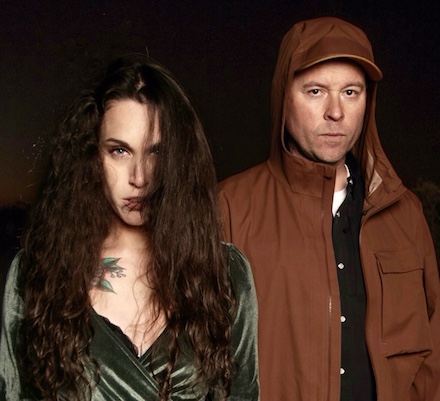
Volores (Shelby and Nathen Maxwell)
The unassuming package arrived, sans celebratory hoopla, a few weeks ago, sandwiched in between bills, various oversized advertisement cards, and several days’ worth of a mail-delivered New York Times subscription. A small, CD-sized, puffy envelope tumbled out of the delivery stack like a relic from the distant past that could no longer fit inside the streamlined box. Which, in a manner of speaking, it actually was. It was the kind of music mailer that any longstanding rock journalist used to receive by the daily tubful, long before being tabled by the recent advent of “Click here to download your copy of Album X” emails. Yes, the TikTok- and YouTube-powered music biz model has changed dramatically over the years. But this mysterious, almost unrecognizable envelope appeared like a bolt out of the blue, or a virtual message in a bottle from a forgotten era. And it contained quite a surprising treasure, with a personalized explanatory note.
The bullet point of this, of course, was that there are some artists out there who still preferred the more personal Old Ways. And when you thought about it, the amount of faith required to simply send this CD out into the impassive ether was staggering (mine was addressed to me, care of an old alt-rock outlet I hadn’t written for in 15, 20 years; I was suitably stunned). Intrigued, I tore the package open, and out tumbled: 1) An actual physical, finished-artwork CD, a sophomore Shores of Scorpio, from a hip-looking husband-and-wife team from a small town in Colorado dubbed Volores; 2) An introductory letter from the guitarist/vocalist wife, Shelby Maxwell, explaining the concept album’s dark theme as having been “born from discovering that my biological father was not who I believed, and the emotional unraveling and rebuilding in the year that followed,” and its production was overseen by her bassist husband Nathen Maxwell, who’s also been playing the same instrument for Flogging Molly for the past three decades; 3) A promotional sticker of the Shelby-drawn logo for the trio (drummer Art Brown rounds out the group), based on a freakish photo she once saw of a stag, with the severed head of its former rutting challenger still entwined in its antlers; and 4) A colorflyer/bio for Volores, folded perfectly so you glimpsed a telling center photograph of the Maxwells as it slid out, her all tattooed Goth and him fully Social Distortion gear-head. There was only one modern-day concession — a hastily taped-on, phone-activated listening link for all the kids who might have forgotten what a CD is or how to play one. The only thing missing— and I found myself shaking the empty envelope just to see if I’d missed it —was the one item many punk bands used to include in their old mailer, a small promotional pin of that creepy logo. Almost immediately, I started crossing my fingers that the record was, indeed, remarkable and worth writing about. It was. In spades.
Shelby insisted on relating her riveting tale chronologically, starting with the opening track “The Poet,” which wafts in on skeletal bluesy guitar chords and Shelby’s smoky plain, which then falls headlong into galloping twin arena-rockers,” The Actor” and the title track. A subsequent “The Paperboy” amplifies everything to a huge, rafter-raising ruckus, and Shelby’s voice rises bravely to the challenge, as it does on a punk-frantic “The Butcher.” And there’s just the right amount of catacomb-echoey reverb on the tribal “The Fortune Teller” before it switches effortlessly from cold to scalding on “The Huntress,” an ode to her favorite pet cat, whose death hit her unexpectedly hard. “The Commodore” and “The Matador” ease the singer back down into a muffled blues miasma, but she hits an almost radio-friendly power-pop perfection on a penultimate “The Stuntman,” then tiptoes out quietly at the end of her self-reflective quest on the gentle closer “The Cosmonaut.”It might have come in a small unsuspecting envelope, but rest assured — “Shores of Scorpio” is a grand, world-class anthemic rock album, the kind they rarely make anymore. “
So, with my editor’s blessing, I decided to reward them with a full-length feature. Minus any publicist, I simply contacted them at the email they’d provided and arranged a phone call for a couple of days later, and at first, the extremely likable Maxwells couldn’t believe it — their Message in a Bottle had actually washed ashore in San Francisco and struck a responsive chord. Ironically, I wasn’t any mood to write, initially — I’d been thoroughly by an insidious hatchet job on myself after a nearly five-decade journalistic career, wherein I’d generously helped hundreds, thousands of Artists, both young and old, and I couldn’t imagine anyone microscopically scrutinizing any of my drug-years mistakes at this point (Yes, I was batshit crazy on cocaine and crank in the late ‘80s, and again on a dopamine-scrambling Parkinson’s prescription called Mirapex in 2018, a true nightmare; sorry, folks — I wasn’t perfect, but I probably wouldn’t have become the same street-savvy, decadence-aware writer if I hadn’t pushed myself to the razor’s edge. But having quit the business in total disgust in 2023, heartbroken that many old friends, publicists, and artists just seemed to give up on me without even letting me address these Targeted Individual charges, I was gradually lured back to writing by some rock-solid well-wishers who stuck around and fully supported me. (I wanted to get my crazy, incredible autobiography done, tentatively “Anagnorisis? Nah!” —but lately I’ve been thinking that my cabal of Naysayers, whom I’ve titled The Van Helsings, just don’t fucking deserve to read it. So this— plus a few more grim things, which I won’t sink back into — was how I was feeling the day I accidentally discovered Volores. And for me, it proved to be a much-needed breath of fresh air. It reminded me of rock journalism’s Halcyon Era, when three, four, five tubs full of similar puffy yellow envelopes would show up each DAY, a cornucopia of musical possibilities I tried not to take for granted. Because you never knew when an amazing new find would show up in, say, a random mailing from MCA I opened one day, and out slid Steve Earle’s country game-changing debut Guitar Town. And I was on the phone with him for the first of many interviews, only two days later. That was the ephemeral Glory Days spirit that this group’s wish-upon-a-star gesture signified for me. So it was imperative that I talk to them, that I used the platform(s) I still had to help. And I ended my chat with the Maxwells the same way I’ve ended all my hand-picked interviews for years: “Thanks for the great record. Now I will do my part and spread the word!” And I meant it, every single time. So now, without delay, is the meat and potatoes of our fun, wide-ranging talk. And I hope it gives other TikTok-mired composers hope. You don’t have to play by new hi-tech industry rules. DIY it instead, sans publicist, and you just might be pleasantly surprised…
IE: I still can’t believe I got your Passenger-pigeon-posted CD! It defies all the odds!
SHELBY MAXWELL: I’m glad it made it to you! We were kind of like, “Hey! Let’s cast a wide net and just see if anybody bites!”
IE: Have you heard anybody else pick up on what you were putting down?
NATHEN MAXWELL: Not in the same way, in such a fun way, as you have. We have gotten some ads on some radio stations, which have been great. But as far as having such a charismatic response, you win that contest.
IE: How old are you guys?
SM: I’m 34, Nathan is 47. We’re 13 years apart, but it works. We met when I was 24, and it was on this cruise that Flogging Molly did. I was on board, and he saw me walking by the pool deck, and I kind of wandered around, ready to see who was saying this. And he was just smiling and waving, so I came over and started to talk to him, and we started talking about synchronicity, and very quickly we became inseparable — we just had a lot of the same ideas and interests in common.
NM: When I first met Shelby, she said, “You know, I’ve heard about you, and I’ve been meaning to meet you.” And she started asking me about some of the lyrics I had written for one of my (non-Flogging Molly) projects. And she said, “You sing a lot about connection and synchronicity, but do you believe in that stuff?” So I let her know that I very much do, and I was very flattered that she was talking on such a deeper level, so I just really enjoyed her company from the get-go. And, as she said, we’ve been pretty inseparable since then.
IE: Where were you living back then?
SM: I was in South Carolina, and he was in Colorado. He’s really from Los Angeles, and I’m originally from Cleveland, Ohio, but I was in the process of moving out to L.A., and very quickly, he was like, “Well, everything you do in L.A., you can do in Colorado, and just fly back to L.A. when necessary. And Colorado is a much better place to live.” So we moved in together probably five months into us dating, and that was 2016. And we got married in 2019, so next month, it’ll be ten months of us knowing each other.
IE: My folks used to vacation in Estes Park every summer.
NM: That is such a beautiful place — we love it. And we love the outdoors, and that’s something that brought us together — our love for nature, getting out and hiking, and just being in the mountains. Shelby loves the mountains, and I love the ocean. But I spend most of my time there, out at mountain lakes and rivers.
IE: Why call yourselves Volores? It’s nonsensical, right?
NM: Well, we were kicking around some band names, and Shelby stopped at the woman’s name ‘Dolores — there was just something about it that really fascinated her. But we’d done some Google searches, and we realized that there was already another band using that name.
But she didn’t want to give up on the feeling that the name invoked. So she went all through the alphabet, until she finally hit V, and Volores, and I just looked at her and said, “That’s it!”We just thought the name had a great feeling to it.
IE: Do you think you’re psychic?
SM: Well, not necessarily. But I connect a lot with my higher self-consciousness and my spirituality a lot. And I get a lot out of astrology, as well.
NM: Many a morning, I’m bringing her coffee, and she’s already got her tarot cards and her pendulum out. And it’s all past me — it’s something above my pay grade. But some of the things that she’s shared with me, like different astrological phenomena? There’s a truth there.
SM: And horoscopes, in my opinion, are more of a quick cash grab a lot of times. But on a deeper level, once you delve into the birth charts and all that, it really does go much deeper. And I definitely pull a tarot card every day, either to guide me in general or to tell me what I need for today.
IE: What influenced you, musically?
NM: There’s an AC/DC influence in our sound, and The Ramones, too. Although our second album is a chronological account of what Shelby has been through.
SM: But everything I’ve ever written has been deeply personal. I don’t have the ability to look outside of myself and write a song that’s just sort of a vibe, where the lyrics mean nothing, and it’s just intended to make you move or dance. So I’m really influenced by Maynard James Keenan and his process with Tool and A Perfect Circle. Some artists will just make the same record, over and over again. But he wanted to move past all that. And some people get upset with Tool for moving on, but I like Maynard’s quote that “If the songs don’t help ME, how are they gonna help you?”
IE: So what’s your creative or even your life’s motto?
NM: “Find what you love, and let it kill you.”
SM: Hey! You can’t steal that! I have a Charles Bukowski quote tattooed on my back, and it says, “Find what you love, and let it kill you.” Because you’re gonna die at the end of it all anyway, so you might as well find what brings you passion and joy and let that be your destiny.
IE: How does “Shores of Scorpio” weave its tale? It starts with “The Pilot.”
SM: Going in chronological order, “The Pilot” would be the confusion and the sadness that I felt throughout this process.
IE: How did you discover that the father you grew up with was not your real dad?
SM: Through a 23 + Me thing. We both had pretty good ideas of where we came from. So we did these tests, but he did his before me, and his was pretty spot-on. And then I got mine back the day after, and ironically, my mom was visiting from Arizona, and she was in the kitchen, cooking pasta. But I got my results, and said to Nathan, “Hey! This is weird! Not only am I not Eastern European, — I’m only 5% that — but I’m 40% Italian!” And my mom kind of bristled and asked to see it, and I made a joke about my dad not being my real dad, and she burst into tears. I had had a really estranged relationship with my dad. He was not a good man, and he struggled with addiction and was just kind of not a good dad. And that’s when I learned that my mom had had an affair with a man at work. And it wasn’t a one-night stand, because they both really loved each other, he decided he didn’t want to lose his wife, and so they cut it o?.
So now she starts telling me all about him (her real da), and I was just about to turn 33 at the time. So I found out. And the man is still married to the same wife that he cheated on. But to add insult to injury, they can’t have kids. They had tried and tried, and just couldn’t have them, so I wound up being his only child. But this is definitely something that I didn’t wanna bring to my dad, the man who raised me. But then he ended up dying from bad health and heart failure, so it was hArd, but it was a blessing in disguise that he passed on before he could find out. So “The Poet” is also about that identity crisis, that confusion, that kind of internal upset of “What IS this?” And it goes into “The Actor,” and that’s the anger, the lashing out about the complete devastation and explosion of my life and myself. I was not happy with the situation, and I was really angry. And then the song “Shores of Scorpio” is about the entire theme of the album, which is about rushing away from what you thought you knew and coming down to something else. It has a lot of astrology built into it — I’m a Capricorn — and then that goes into “The Paperboy,” about my finding out, then ” The Butcher” is about Joe, the guy who raised me, not taking accountability. And “The Fortune Teller” is about my ability to catastrophize anything, because I protect myself by imagining the worst-case scenario first, so if anything better than that happens, it’s much better than I thought. “The Huntress” is a love song about her favorite cat, Bean, and then “The Commodore” is basically a letter to my biological father and his wife, because he had to eventually tell her about me, and that goes into “The Matador.” Nathan once told me during an argument, “You know, I just can’t keep up with you! You’re running circles around me!” So it’s about where I lash out and defend myself, really quickly, so fast you couldn’t really keep up with me. So I’m the bull, running around, just so I don’t hurt anymore myself. And that goes into “The Stuntman,” which is the final stretch of what I’m feeling, and I understand that back in the day, it wasn’t easy to get a paternity test, while now you can get ‘em at a Walgreens. And my mom was young at the time — she was only 22 when I was born, and she was scared, and nobody had found out about the affair until I got mt 23 + Me test done. Because there is NO Italian in the rest of my family.
IE: What did you learn from the writing experience?
SM: It was just about finding the acceptance in that I get to choose who I am. And that none of it all matters in the end —it’s about the journey and how you choose to live your life, and nobody can decide what that journey is but you. So nobody can tell me who I am except myself.
-Tom Lanham