Cover Story: nothing, nowhere.
Cries for help don’t come much more urgently. Last month, brash young Saturday Night Live comedian Pete Davidson — who had joked for months in sketches about being diagnosed with borderline personality disorder — lost any remaining shreds of humor about his often-debilitating condition when he posted an alarming message on Instagram, right before he deleted his account. It read, “I really don’t want to be on this Earth anymore. I’ve done my best to stay here for you, but I actually don’t know how much longer I can last. All I’ve ever tried to do was help people. Remember I told you so.” The finality of it was so frightening that even Texas Rep.-elect Dan Crenshaw — a former Navy SEAL who Davidson had mocked a month earlier for wearing an ominous eye patch — phoned his antagonist to check on him and offer helpful advice.
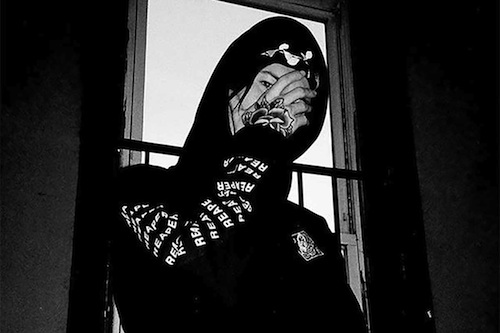
For celebrities these days, mental illness is no laughing matter. But not everyone relies on — or trusts — social media to communicate their turbulent changes of mood. Some, like the Vermont-and-Massachusetts-reared rap-rocker Joe Mulherin, who writes and performs under the lower-case moniker nothing, nowhere, don’t bother firing any online warning shots about what they’re experiencing. They let it all out in cathartic songs, like this artist’s new stand-alone military march of a single, “Dread,” one of the most squeamishly uncomfortable anthems ever penned. And if it feels like it was torn from a private diary, that’s because it essentially was. Yet it’s every bit as compelling as Davidson’s faux-farewell note.
“I look into the mirror, all I’m seeing is a skeleton,” the artist rhythmically mutters in “Dread.” “I keep losing weight, so they’ve got me taking medicine/ I can’t go a day without relying on these sedatives/ Therapy and doctors, I feel like a specimen.” And with that haunted verse, he takes off the gloves and really comes out swinging, “Every fucking night that I’ve been laying in my bed/ Doing all I can to fight the certain sense of dread/ Feeling like this panic that I have will never end/ And so I fantasize about that gun up to my head, yeah.” And the sinister, but sing-song chorus hammers it all home: “I wanna know when the pain stops/ Walking around with the same thoughts/ Face down, fucked up with the door locked.”
Nope. No laughing matter, indeed.
The genesis of “Dread” was simple, its composer relates offhandedly. When panic attacks and their attendant jagged lashes of depression began mounting on him last spring, he made a startling decision that’s anathema to these greedy, Gordon Gekko-ish times — virtually, overnight he nixed his entire summer tour with a posting on Instagram that declared “Our tour is cancelled. I’ve been battling severe anxiety and depression and decided the best option is to leave for a while and seek professional help. I’m sorry. See you again when I’m feeling better.” Then? The line went dead as he squealed his career to a halt, signed off of a juggernaut that would have taken him to Britain’s Leeds and Reading Festivals, and delved into various treatments for his disorder. No daily status updates on what mood he was currently in (‘Gasp! Can you imagine?’ Some of you device-dependent whelps out there are probably recoiling in horror at the idea of not alerting the world to every last minute of your Walter Mitty existence, but it’s doable. Totally doable. And the world will get along just fine without all those bloated bulletins, thank you very much — nobody gives a shit what you had for brunch today or how poorly it was undercooked.) “So after I had to cancel the tour last summer and seek therapy, I decided to just put it in a song instead of offering a statement of some sort,” he says. He didn’t feel it could easily be condensed into a press release.
The similarly-shrewd Davidson will most likely bow out of the rest of this season on that potentially crippling SNL pressure — his future, like Mulherin’s, is that blindingly bright that its’ worth a small sacrifice early on to maintain proper propulsion. What solution did he settle on? Not merely one, but several says the straight-edge 26-year-old, who has never been tempted by the smoking, drinking, and drug use that most kids his age have lived through by his age. “I had a vast array of options, and I wanted to attack it from all angles,” he recalls. ”So I took the traditional route of psychiatrist/therapist, and my mom’s a nurse, so she guided me through that whole thing. But I also took the whole traditional Eastern route. I’m really into Buddhism and Taoism, and meditation has been instrumental in my recovery, and in my everyday life now. So I sort of tried everything out and figured out what works for me, which is a little bit of everything.” There used to be a stigma surrounding one’s need for therapy — an admission of frailty, powerlessness that was more feminine than masculine. But Imagine Dragons’ Dan Reynolds — frontman for a band that continued to top Spotify playlists and Billboard charts with its fourth album Origins last year — openly swears by cognitive therapy, which helped him machete his way out of a kudzu-ed mental funk. “So the stigma is being lifted a little bit,” Mulherin adds. “And therapy is important — you just can’t keep these things inside. But I do think, in some ways, there’s a sort of mental health awareness revolution going on. And that’s a big step in the right direction.”
Long before he began uploading acoustic originals on SoundCloud in 2015 under the anonymous banner of nothing, nowhere (leading to his DIY debut that same year, The nothing, nowhere LP, then 2017’s Reaper and a coveted contract with Fueled By Ramen for last year’s Ruiner) was battling childhood demons that few outsiders could comprehend. “I’ve had anxiety since about second grade, and I remember finally going to therapists, where I was diagnosed with anxiety and panic attacks, and it’s been something that’s come and gone throughout my life ever since. And unfortunately, this past summer. It came back really, really strongly, so I decided to take the time that I needed. The time I needed to recover. And hopefully, it will set an example for other people within music and the arts to show that if you’re overwhelmed or you’re struggling, you need to take the time for yourself, because you are not going to be functioning at your best abilities if you don’t address that.”
Anyone paying close attention to Mulherin’s career should have been worried a long time ago. First, there’s that moniker, which alone suggests a long exhalation of futile ennui — a general surrender to malevolent forces beyond your control. Kind of in a post-ironic, self-deprecating sense, but kind of not. Nothing, nowhere has a distinct style now, consisting of military-academy click tracks wreathed with his neighborly, conversational rapping that’s never aggressive or threatening. Which makes it all the scarier when you pick up on the dark thoughts he’s putting down. And you can hear him lose control in real time. Like Eddie Brock wrestling with that demanding alien symbiote in Marvel Comics’ book and movie Venom, the auteur starts out on Reaper defiant, full of piss and vinegar in “Hopes Up” (featuring Dashboard Confessional), “Black Heart,” “Clarity in Kerosene,” and “Funeral Fantasy,” wherein he imagines a you’ll-be-sorry-when-gone scenario at his hometown mortuary. But on the following Ruiner — with every track ending in ‘er,’ you can feel the constrictor coiling around him, tightening, tightening, from the falsetto optimism of “Reminiscer” through the problem-noticing “Better” and the title cut, which first broaches suicide as a viable solution. And the difficulties — and pressure — just keep mounting for the poor kid, who can only fight back with his music. And after all, he did dub his discs with ghoulish titles like Reaper. “I’ve always been an overthinker, and I think that’s where my anxiety comes from. And overthinking your own mortality just goes with all that,” he observes.
“The worst part of it was for four or five months there; I couldn’t even go to the grocery store,” the singer says. “I had a panic attack every single day. It was pure hell.” But he also saw it as a teachable moment and was open to gleaning positive insights from pure terror. “And I guess the main thing I learned about myself is that I am not my feelings, and that feelings aren’t facts. I learned that you can be the observer of your own emotions, so I don’t say that I’m anxious — I say that I’m feeling anxious. And I learned a lot of that from my meditation practice, which is really helpful for me. Because sometimes when you’re in it, it feels like there’s no escape. But through mindfulness, I’ve found that there are ways to sidestep it and get better.” He understands that suffering often set the stage for some compelling art (or at least some snide Venom-versus-human verbal conflict). “And it’s sad, but true,” he allows. “But in Buddhism, the Dharma is your special, unique set of skills and how you use them. And for me, that’s music. So I would much rather not have to go through what I’m going through. But I get to create these things that people get to listen to, and maybe they’ll realize that they’re not alone. That there is something worthwhile, waiting for them out there.”
Someone recently posited that there are three types of people in the world — Seers; Those who can see only when they are shown; And those who will never see. Mulherin likes this concept and considers himself to be one of the enlightened former. “I’m always in that space where — especially in the creative arts community — there’s just a different layer of feeling,” he says. “And there are crummy things that can come with that. But I feel like there’s a sixth sense within people who have a creative mindset. I mean, why do some of my favorite artists have to be some of the most tortured people? I’m just talking out loud here, but all I know is, I’ve never been in a great mood and been compelled to write a song about it. I guess I just have a different type of brain.”
Strangely, Mulherin has acquired all of his hard-won wisdom without the benefit of being a rabid bibliophile; he’s merely lukewarm on books. “My mom and dad are avid readers, and my girlfriend Kate, she’s an English teacher,” he confesses, sheepishly. “So I ingest my infotainment and my information through documentaries — I’m more of a visual learner than an auditory learner, so I listen to a lot more things than I read. But I’m always searching for a new philosophy, just new controversial theories to think about. And I love Eastern culture, even nihilism, and pessimism, even the dark stuff. I just love thinking about thinking.” And he juggles all of this in a motley daily regimen designed to keep him on track, not squealing off the rails on some crazy train.
“Before this summer, I lived in a really wishy-washy way,” the vocalist says. “I’d stay up late, and I’d sleep late — I didn’t really have a schedule. So I really had to regiment my life. And as soon as I’d wake up, I’d do RPMs — Ride, Pee and Meditate. So I’d meditate for about a half hour, 45 minutes, then I’d go for a walk or ride my bike and try to get myself moving. Now I just make sure that I’m eating well, and that I also meditate each night before I go the sleep. I basically just keep checking- in, and to meditate a few times a day as part of that checking in.” He’d like to have a base of operations, a place to call home, but he’s still a vagabond, bouncing between the low-key Massachusetts and Vermont towns in which he grew up. “It’s kind of hard when you’re always on the road, but I’m actually looking for a place to live in Vermont, in the middle of nowhere. And — fingers crossed — we’ll see how it goes.”
Which begs one crucial existential question — does such solitude help or hinder him, emotionally? He laughs. “A little bit of both,” he replies. “Hopefully I’ll have some roommates and people around me because I certainly don’t want to live alone alone. And I do have my significant other, so I’m really grateful for her. But it’s different because we were together before I started touring and before I made a career out of music. So she’s amazing and incredibly important to me, and I’m really glad to have someone who supports me in that way.”
Mulherin finds it inherently ironic that a Gothic, spleen-venting primal scream like “Dread” has now become a product to be bought and sold. “It gets interesting when you’re mixing business with art,” he notes. “But I just write to help me, and then, in turn, I hope that helps other people.” Has there ever been a nothing, nowhere dirge too dark to release or recreate in concert? He guffaws. “I listen back to all my stuff, and sometimes I just can’t even listen to certain things. So there are songs I’ve shelved because I don’t really want to put myself in that headspace again. Sometimes when I listen back to a song, I’m just grateful that I’m not there anymore, ya know?”
– Tom Lanham
Category: Cover Story, Featured, Features