Cover Story: George Thorogood
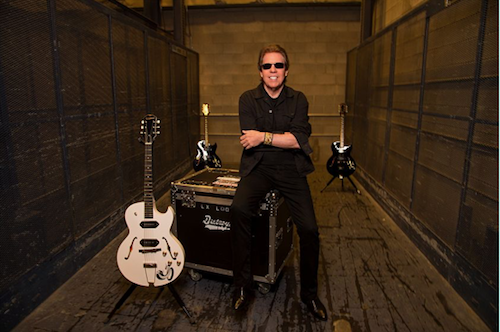
George Thorogood
By all accounts, it was a triumphant prodigal-son homecoming: The night of November 23, 1982. when the newly-crowned Tazmanian Devil of roadhouse-scruffy blues George Thorogood and his backing band The Destroyers tornadoed back into their adopted hometown of Boston sprawling, 27-song set at a club then known as the Bradford Ballroom. After making his mark with two classic discs for Rounder — 1977’s George Thorogood and The Destroyers and Move It On Over in 1978 — he’d staked his rock-history claim with 1982’s signature Bad to the Bone single and album, featuring Rolling Stones accompanist Ian Stewart on keyboards, following a 1981 U.S. tour opening for Mick and Keith, as well. And last month, before Christmas, Rounder finally issued the concert in all its maniacal glory on the two-disc Live in Boston 1982: The Complete Concert, immortalized in the cover shot of a frenzied Thorogood leaping almost Looney-Tunes high above the venue stage that evening. It opens with a rousing rendition of Chuck Berry’s “House of Blue Lights,” caroms through classic covers like “Cocaine Blues,” “Who Do You, Love,” his trademark serpentine “One Bourbon, One Scotch, One Beer,” and builds to a crescendo with “Bad to the Bone,” “Nobody But Me,” and “No Particular Place to Go.” However, upon reflection, a disarmingly humble Thorogood, now 70, can’t recall anything specific that set that show apart from any of the countless others in his still-bustling career.
“Speaking for myself — I don’t know about the rest of the band — ALL the shows are special,” the mongoose-throated growler cedes. “We’re hired to do a gig, and that’s what we do. But I heard this story that when they asked Stan Musial what the greatest day of his life in baseball was, he said, ‘The greatest thrill for me was when I ran out every day onto the field with St. Louis Cardinals on my chest.’ So I’m kinda like that. My most special gig is every night when I walk out there with my Destroyer’s shirt on. That’s it for me, right there.” Ergo, you don’t really interview the man as much as go on a wild, topical rollercoaster ride with him, which even includes him asking you a few questions, for which only he — like the late Alex Trebek — knows the correct answers. What is the single emotion that all human beings experience at one point or another? Not love, he insists. It’s a pain — that’s what makes classic tunes like “The Thrill is Gone” and “Somewhere Over the Rainbow” so perfect and poignant, the anguish lurking within their melodic confines. And what’s the greatest blues song ever written? No, it’s not what you’re thinking — it’s “Yesterday” by The Beatles. “It’s the saddest song I’ve ever heard and also the most beautiful, a young man singing about the death of his mother. Now, what can be sadder than that? And that’s the most universal song on the planet. So the blues,” he adds reassuringly, just in case you were wondering, “is never going to go out of style!”
IE: How’s it going?
GEORGE THOROGOOD: Bad. It’s bad.
IE: Well, hopefully not….to the BONE!
GT: Yeah, that’s the idea. Hey — not the best way to start off a conversation. But it’s kind of a trademark thing with me. How are things up there in the City by the Bay? San Francisco — that’s my town, man. I actually kinda started out in San Francisco, in Ghirardelli Square and Union Square, and on Grant Avenue — those are my old stomping grounds. I was living there, but I wasn’t living high on the hog, believe you me. I stayed where anybody would put me up — I was a street musician; I played in the streets. I got there at the beginning of February of ‘73, and I left around late April, and I spent most of my time playing on street corners, at Fisherman’s Wharf, Chinatown, and like I said, Union Square — anywhere there wasn’t a cop, I’d pull out my guitar and play. And the people in San Francisco were really great to me — street musicians were treated really well. And a lot of times, they didn’t put money in my guitar case — they put food stamps, so they’d make sure you didn’t spend your money on drugs or booze. They made sure you got some good food in you. And I remember hitchhiking on the highways — there’d be 20, 30 kids standing in line to hitchhike, and I’d step up there, and if you had a musical instrument, they always put you at the front of the line, first. Just to honor the fact that you’re a musician. And if you were successful, you wouldn’t need to be hitchhiking, so obviously, they figured it out, like, “This guy is just starting out or struggling.” And that was the attitude of the whole city, just about everywhere I went. And Mark Twain was right — the coldest winter I ever had was a summer in San Francisco, and how Willie Mays hit all those home runs and caught all those fly balls there, I’ll never know.
IE: In Australia, the buskers have to get permits that stake out their turf. Was there a handshake agreement between you and other street performers about who got to play the prime territory and when?
GT: Well, at the time, I knew John Lee Hooker was living in Oakland and playing on Ventura Avenue. And I went to California to meet him, to see if I could get a job playing in his band because I had John Lee Hooker’s style down pretty great, or close enough to make me think that I could get in a band with him. And I actually did meet him, and I went to his house, and he was wonderful. But it was brief. And I had already stopped him at the Coffee Gallery one night — I was really sick and had a bad cold — and I played a few songs because people took mercy on me and my friend put us up. But I didn’t assert myself enough — I didn’t say, “Hey, John — put me in your band!” So I saw other people playing on the street, and they said, “Oh, you’re hungry, huh? Well, no one’s gonna just give you a sandwich outta nothing — you’ve gotta do what these people are doing.” So it was a matter of survival.m I was talking to the late Norton Buffalo — may he rest in peace — one time, and I said, “You know I used to play in San Francisco on the streets.” And he said, “Oh, I had a street band there — me and Huey Lewis played on the streets! We used to play Ghirardelli Square.” And I said, “Me, too!” And he said, “Yeah — it was a lot of fun!” And I said, “FUN?” And he said, “Yeah — I played on my college breaks.” And I thought, “Oh. That’s nice…”
IE: Where some of your scarier SF nights spent crashing?
GT: Uhhh…I wouldn’t advise it. Now, though? I’ll tell ya — I’ve been back to San Francisco a few times recently, and I took my daughter out to Fisherman’s Wharf. It’s all changed now, it’s really fantastic, and I see that the street musicians there have got their own PA system and electric guitars, with a mechanical drummer. It;’s advanced a lot further from when I was doing it — it’s a lot more sophisticated now, I should say. And I made very little each day. I think I pulled down maybe $6, $7 bucks at the most, on a good day. And it’s funny — there was a restaurant in Ghirardelli Square, and I used to play right across the street from it. And I’d say, “Someday, if I ever get successful, I’m gonna go have dinner at that place. Some day…” And years later, I came back, and I took my wife and my daughter, and I spoke to the waitress there, and I said, “You know, I used to play right over there, and I always wanted to eat in this place. And now I can finally do it!” And she said, “Oh, yeah! You played right over there! You were that singer with the slide thing happening — I remember you!” And I was like, “God! That was a thousand years ago!” I can’t remember the name of the restaurant, but it was a wonderful place. And I remember that I actually wore out my shoes. And a guy loaned me a pair of shoes that were really awful shoes — they were cutting into my ankles, and my ankles were bleeding, chafing. I was really in agony. And a woman saw me playing and took my friend and me in and let us sleep on her floor one night. And she says, “I’m not kidding you — you’re in bad shape here!” And I said, “Yeah, but I’ve got these shoes, and that’s all I’ve got — I don’t even have any socks.” And she said, “Listen — I just got a new credit card from Sears, and I just got it two days ago.” So she took me down to Sears, bought me a pair of shoes and a pair of socks, and I can’t remember her name or who she was. But my God, she was like an angel! If I could find her today, I wouldn’t just buy her dinner — I’d buy her a seven-course dinner! But that’s the kind of people who I ran into in San Francisco — I was very fortunate to bump into people who really wanted to help you out. And then I came back there a few years later and started to play around the Bay Area when our record broke. It was the Bay Area; actually, that broke our first record — KFAT and KSAN got us going, and we went in and bombarded the Boarding House, it was called at the time, played around there. So it was the San Francisco Bay Area that really kicked it off for us.
IE: Not to be blithe, but dare I ask it? Have you written your take on a “COVID-19 Blues” yet? “I woke up this morning and..” And what?
GT: Well, you know, with the world of songwriting, I’ll sit there and think, “Maybe I’ll write a song.” But then I’ll listen to Hank Williams, and I listen to Chuck Berry and The Beatles and Bob Dylan, and I go, “Why? These are the greatest songs ever written! The world doesn’t need another one! And those songs are still being played, over and over and over, just like “The Godfather” is being played over and over, or The Wizard of Oz or Gone With the Wind. Those are the greatest songs ever, and my little thing I write is like comedy songs, very tongue-in-cheek. If Paul McCartney is Shakespeare and Bob Dylan is Steinbeck, then George Thorogood is Rodney Dangerfield.
IE: But here’s a weird twist. Almost instinctively, once the pandemic hit, I started playing your first two remastered Rounder albums on the iPod. And it felt like a shot of adrenaline. It felt like punk rock.
GT: Well, it’s funny because that first record didn’t get too many good reviews. And one rock critic was listening to it and said, “Well, this guy is guy is obviously trying too hard to sound dirty and funky and make it sound authentic.” The guy really didn’t like it. And Billy, our bassist, laughed, and he laughed when people said the same thing about the second record. And he said, “No, you’re wrong. This is as CLEAN as George can play. George has cleaned up his act for this record. You’re missing it — he’s not playing dirty on purpose. He’s trying to play clean — he wants to sound like Jeff Beck, so he’s trying to smooth it out!” And that’s what they just didn’t get — that I don’t play dirty on purpose. Johnny Rivers and I were talking once, and I said, “You know, with the guitar I play, I really try to get that crisp, clean sound that Beck gets, but it always comes out so trashy and dirty. Maybe I should get another guitar.” And Johnny Rivers went, “George, it’s not the guitar.” It was me, exactly. So I’m stuck with it — what can I tell ya?
IE: And your secret is, you’ve interpreted blues obscurities and classics and simply made them your own with your own signature sound until the only versions people remember of the songs are yours.
GT: I never set out to do that on purpose. I’m trying to play it, note for note perfect, just like Keith Richards did with the first two or three Chuck Berry records, that he and Brian Jones religiously got down — they got all those notes perfect. So when people say, “Well, that song by such-and-such — you’ve made it your own,” well, that’s how it was designed. I’m just trying my best to keep up with the big boys! And play it right. And fortunately — or unfortunately, however you want to look at it — this is just the way it comes out.
IE: Well, as this new live album makes clear, you’re as generous with your marathon concert sets as Springsteen. And you can seemingly leap as high as him — may be higher — in that awesome cover photo.
GT: I never really thought that there was anything unusual or strange about working hard. I mean, every show I saw John Hammond do was a high-energy thing, and I was brought up believing that you’re supposed to work hard. Lou Gehrig worked hard. Cal Ripken worked hard. Willie Mays worked hard. So when I started going out there, and there was this splash about Bruce Springsteen — with all due respect because the guy really works hard — they were making a big deal about it, I was going, “Well, what’s the big deal? Isn’t that the standard? I mean, didn’t James Brown or Mitch Ryder work hard? This something new?” Well, to me, it wasn’t. This was just standard procedure — you did your job, and you kicked ass at it. When we worked the clubs, we worked our asses off because we figured maybe we wouldn’t get another gig tomorrow! And we still do that! People ask, “Well, what gig are you working for?” And I’m like, “I’m just hoping that they’ll hire me back after tonight!” That’s our deal.
IE: Early into the pandemic, in the comic strip “Pearls Before Swine,” one of the animals approached another with a pen and clipboard and asked him to list his biggest aspiration in life. The other animal thinks about it, then replies, “To be alive next week.”
GT: There ya go! That’s a real, realistic way of doing it. People say, “Well, how long do you wanna live?’ And I say, “I want to live to be 71.” And they say, “How old are you now?” And I say, “70. And when I’m 71, I wanna live to be 72.” So I’ve been chugging along with that attitude for years now — that kind of thing never leaves you. And I think that the thing that’s the greatest motivator in the world is fear — it’s bigger than anything. I go to see Tom Jones and Paul McCartney every chance I get, and I sit as close to the stage as I can, or if I don’t sit as close to the stage, I take binoculars. And two things that I’ve noticed in them when they perform — and I look at ‘em really close, I look ‘em in the eyes — they still have a look in the eye like they’re hungry. McCartney looks like he’s still playing in Hamburg, trying to get it together. I still see that glimmer in their eye when they’re playing a show. When I watch The Rolling Stones play, Keith Richards and Mick Jagger look at each other and shake their heads, like, “Can you believe this really is happening to us?” And they still do that to this day. And to me, if you lose that? You might as well stop playing.
IE: Have you ever faced a moment in your life when you thought you might be losing it?
GT: Well, to lose it, you have to have had it, to begin with. So that’s flattering if someone says I’ve got it because that never really dawns on me. So to me, ‘losing it’ means losing a gig, losing a job. But maybe if I have a migraine headache or something heavy hits me, I’ll waver for a second. But you’ve still gotta do what you do. And I hate to say this because it might sound a little egotistical or over-fluttering, but if I say, “Well, maybe I’ve had enough,” people say, “George, maybe you’ve had enough, but your FANS haven’t had enough!” Now that is a rule of thumb right there. That’s the law. Because I’ll always say, “Well, if they haven’t had enough, then I haven’t had enough!”
IE: Has your daughter followed in your musical footsteps or turned 180 degrees the other way?
GT: Well, that remains to be seen. But I’ll tell you what, man — at 22, my daughter plays a mean rhythm guitar. She plays “Jumpin’ Jack Flash,” the right way like Brian Jones used to play it. One day on Christmas day, I came downstairs and couldn’t find her, and all the gifts were still wrapped and sitting under the tree. But she was in the backroom, and she’d figured out how to play “Lucy in the Sky With Diamonds” on her guitar. And my favorite thing she does is she has “Harvest Moon” by Neil Young down — I love to hear her play that. It’s beautiful.
IE: Have you picked up any strange new hobbies during a lockdown?
GT: No. That’s just not me. I don’t frisbee; I don’t mountain climb. Maybe someday, when I’ve only got a couple of marbles left, I’ll take up birdwatching or something gentle like that, or get a telescope and be a stargazer. None of those things ever appeal to me. Pretty much ever since I was 15, I’ve had a one-track mind. People will say, “Oh, let’s go do this!” And by the time we’re bowling, and we’re halfway through the second game, my mind is going, “Hey! I know a song that we could do the next time we play! I’ve gotta write that down!” So you can’t stop what you already are — you just can’t cut that out. So I’ve been doing what they tell me to do lately — stay home, wear a mask, and get tested as often as possible. And I don’t really have any place to go anyway, so I try to get as much exercise as I can every day and keep the body moving. So I basically just exercise. And oh yeah — play the guitar!
-Tom Lanham
Category: Cover Story, Monthly