Media: April 2026 • 100 Years of Sirens In The Loop
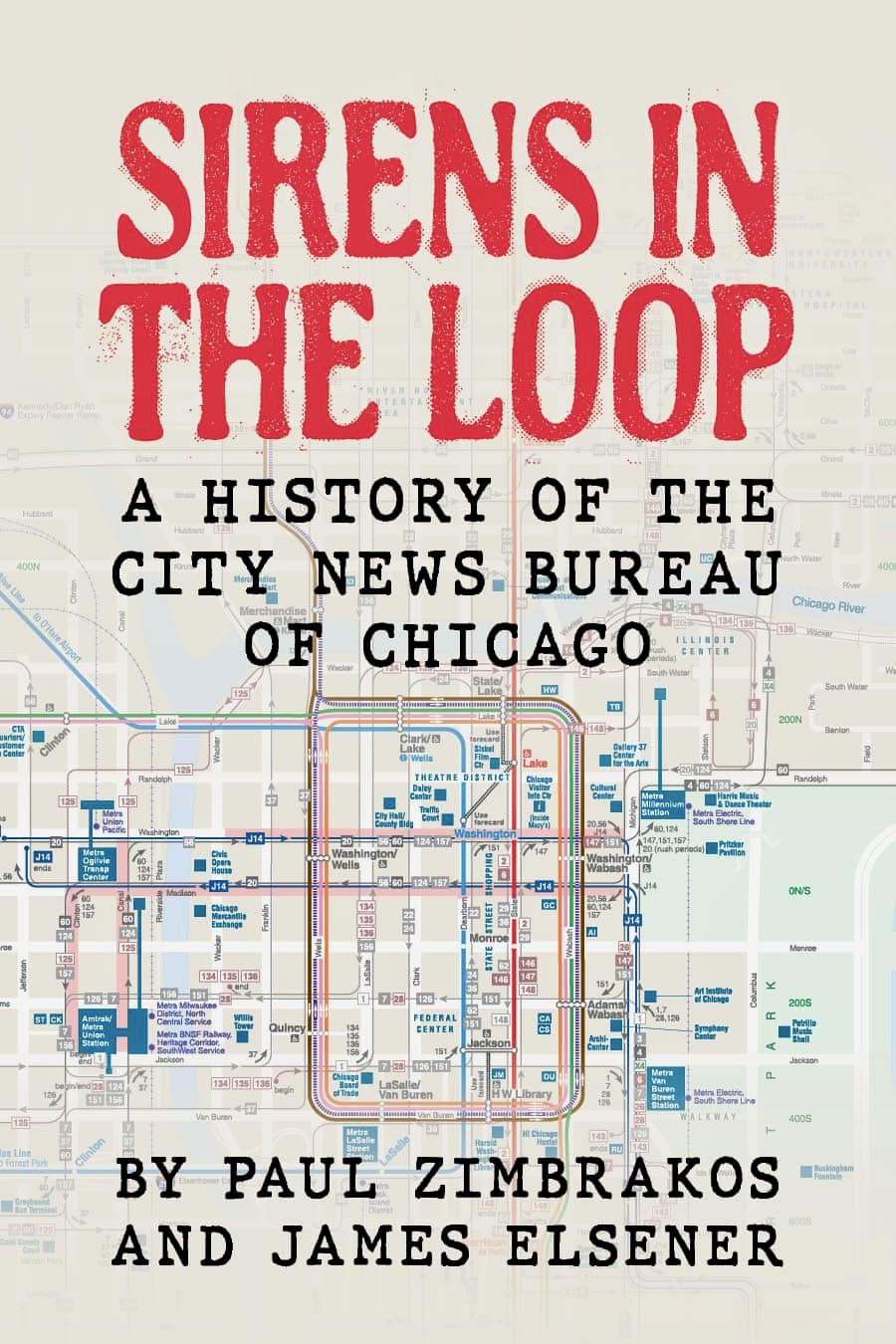
The journalism business has obviously changed dramatically over the past few decades. The latest book about the history of the Chicago News Bureau (Sirens in the Loop), written by Paul Zimbrakos and Jim Elsener, really shines a spotlight on just how much it has changed. The City News Bureau was a news cooperative, meaning its reporters collected news to be shared with multiple clients.
“It was owned by the Chicago newspapers,” Elsener explains, “but the New York Times was also a client, and so was the Associated Press and United Press International. We had reporters out 24/7 in the police stations. That was always kind of the first primary coverage area. And then during the usual business hours of nine to five, we had reporters covering the federal courts, the criminal courts, City Hall, and the Board of Trade, generating copy for use by the radio and TV stations. We were basically the news department for many small radio stations. The business model was to hire young, energetic, enthusiastic journalists who were usually in their first job. Meaning—cheap.”
The title of the book, Sirens in the Loop, paints a pretty good picture of the bureau’s role.
“I have to give credit to Wayne Platt,” Elsener says, “who was our assistant city editor at City News Bureau. The thought behind it is that at CNB, our offices were always downtown or very close to the Loop, so you could hear the emergency vehicles in the city when they were going through. Police cars, fire trucks, ambulances. We would put out a bulletin to all our clients saying, City News Bureau hears ‘sirens in the loop,’ and will be following up. We always did the necessary phone calls to the police and fire organizations and so on. So that’s where that title comes from.”
The book was begun by CNB veteran Paul Zimbrakos. “Paul came to City News in 1958,” Elsener explains, “and he was a copy boy at the Daily News before that. He went through all the various reporter positions, police reporter, courts reporter, City Hall reporter, you name it. And little by little, he became the assistant editor and then the city editor in 1968. I came in 1970. He was a mentor to me. I wasn’t the only one. I tried to put some numbers on it. It’s certainly close to 1000 different journalists who came through there in the next 43 years that he trained in one way or another.”
But while he was writing the book, Zimbrakos got sick. That’s when he called Elsener. “I first started talking to Paul about a year and a half before he passed away,” Jim explains, “and he knew he was running out of time and energy, and he said, you know, I’m not going to be able to finish this. When he passed away in 2022, three big Rubbermaid boxes of e-mails, articles, and correspondence just kind of sat in the corner of my office. Finally, in the fall of 2024, I decided to take a deeper look at this. So when my wife went out of town with her sisters for girls’ week, I pulled all this stuff out, sat in the living room, and just started organizing. I ended up with probably about 30 different piles, which ironically turned out to be the Table of Contents. I started writing it seriously in November of 2024.”
The long list of Chicago City News alumni is amazing, as you might expect from an organization that lasted over 100 years. “Let’s start with Mike Royko, Pulitzer Prize winner,” Jim says. “Kurt Vonnegut. Slaughterhouse Five, probably his most popular book, talks about his time at City News Bureau. Seymour Hersh, who is best known for breaking the My-Lai Massacre story in Vietnam. And if you have an opportunity to read his memoir, which is entitled Reporter, you’ll find that he broke that story just by following the basic journalism tenets that he learned at City News Bureau. David Brooks is a well-known **New York Times and Wall Street Journal columnist. He worked at the City News Bureau in 1984. The queen of investigative journalism in Chicago, Pam Zekman, who was with the Tribune, the Sun-Times, and CBS News locally, broke so many big stories; she’s another one. Charles MacArthur, who, with his co-author Ben Hecht, wrote the famous Broadway play and movie The Front Page.”
So why is City News no longer around? “The news business began to change due to the internet in the late ’90s. The type of news we were covering wasn’t deemed necessary anymore, the way it used to be. So they sold that business for about $25 million in 1999. That money was split between the Chicago Tribune and the Chicago Sun-Times. They closed the doors at midnight on February 1, 1999, and 18 staffers walked across the bridge on Michigan Avenue, entered the Tribune Tower, and went up to the fourth floor. They had some offices, and that’s where that group of people worked for another five years, till finally, the Tribune decided it wasn’t worth it anymore. You know, the CNB was never invented to make money. It was there to save money. When it no longer did, it was gone.”
But that long, glorious history remains in the pages of Sirens of the Loop (Eckhartz Press).
-Rick Kaempfer
(Editor’s note: Rick Kaempfer is also the co-publisher of Eckhartz Press)