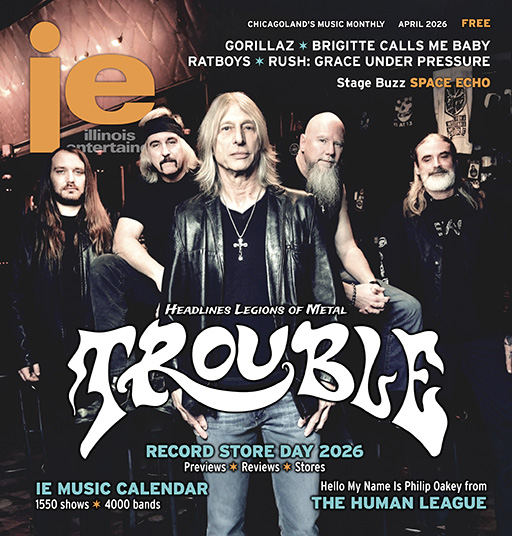
Cover Story: Lil’ Ed and The Blues Imperials • Blues in our Blood
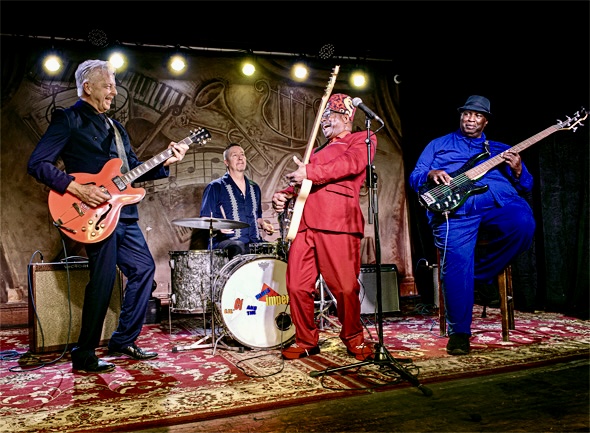
Lil’ Ed and the Blues Imperials
Chicago Blues guitar icon, Lil’ Ed Williams, has been churning out his brand of classic yet contemporary Blues compositions for over four decades.
Williams has played the renowned Chicago Blues Festival multiple times, and on Friday, February 27, 2026, at FitzGerald’s in Berwyn, Lil’ Ed & The Blues Imperials will be playing a “hometown” record-release show.
GROWING UP WITH THE BLUES
Born in 1955 in the heart of Chicago’s notorious west side, Williams grew up in the Garfield Park neighborhood. Given the bad reputation some west-side neighborhoods had at the time, Williams had a pretty normal childhood. “Actually, I didn’t have to deal with (any bad stuff),” Williams explains during a recent phone interview. “Where I grew up, it seemed like everybody was getting along. There were a few little issues. There were some gang members around at the time, and we used to look out the window and see them fighting every once in a while. As far as racial activity there, there wasn’t really anything because there were a couple of white people who stayed right around where we were, and they were nice people.”
While growing up, Williams turned to music and began playing the guitar, then the drums and bass around age 12. Williams and his half-brother, James “Pookie” Young, received encouragement and music lessons from their famous uncle, the blues slide guitarist J.B. Hutto, who laid the foundation for Williams’s musical career. “I was already watching Uncle J.B. heavily because the first time I’d seen him play, he had his band over and they were playing in the backyard,” Williams remembers. “That’s when I noticed that he liked to walk on things. They stacked up these garbage cans, and J.B. was walking on these cans, and it blew me away. Because here’s a grown man out here walking on garbage cans playing the guitar with a hundred-foot chord. He’d come into the house and start playing in the living room with my great grandma, too. That’s how I really started watching him because I was sneaking a peek. We weren’t allowed in there when they were drinking and having a good time. He told me to sit down, be quiet, and not say a word. But every once in a while, he would ask, ‘You wanna play this thing, don’t you?’”
As everyone should know by now, Chicago has such a rich musical history, especially with the blues. Witnessing what his uncle, the Blues pioneer J.B. Hutto, had accomplished in this city made Williams want to chase the same energy he exuded. “It’s the feeling that the people give me; it’s the energy that they feed me,” Williams confesses. “I think that’s the thing I really like about it. It was so exciting to see my uncle do that. Because I had no clue what was going on. To see him do what he did, it just soaked into me like a sponge because I knew I wanted that right at that moment.”
After J.B. passed away in 1983, Williams struck out on his own while still at a young age. “My auntie, who raised me, actually got my first gig in a bar,” he remembers. “It was called the Garfield Club; it was on Madison and Homan. The bar was really long, and the stage was level with the bar. So we had to come from the back of the stage, then walk up to the bar and onto the stage to get up and play. And people were sitting right at the bar. So I remember playing, and my sisters were dancing, and everybody was having a good time because all of my family was there. I remember dropping down on my knees and started crawling down the bar and the people went nuts.”
VINTAGE FINGER PICKER
Williams formed the first incarnation of The Blues Imperials in 1975 with his half-brother “Pookie” and played their first gig at a west side club called Big Duke’s Blue Flame, making $6 a piece.
Around this time, Williams’ musical style began to develop. While staying true to the classic blues sound, Williams also developed a more contemporary approach to Blues guitar playing. “I do fuse them both together,” Williams admits. “After J.B. passed, I had to search for new stuff, new styles, and new patterns. Even though every time I played, J.B. taught me that people would enjoy it; they would go crazy. After my uncle passed and I was staying with my mom, I found this box of albums in the alley one morning. There were some clothes stacked up on the garbage can, and there was this box. I looked in the box, and there were all these albums. So I get these albums, and I run upstairs to show “Pookie.” There was Elmore James, Muddy Waters, Johnny Lee, John Littlejohn, and Albert Collins. And that’s why I started picking up a little bit more contemporary blues style because I was listening to all this good stuff.”
Williams’ finger-picking guitar technique—playing without a plectrum—honors the vintage bluesmen that preceded him. In addition, by placing the slide tube on his pinky finger—while most blues players before and after him have placed it on either the ring or middle finger—allowed Williams more freedom with his bluesy licks. “That’s because J.B. played with it on his pinky; I learned that by watching him,” Williams confesses. “I did see other musicians when I started playing with the slide on the middle finger, and they confused me. As a matter of fact, John Littlejohn told me that I was playing backwards before he passed. He told me I was playing it wrong and that I would never get it right. Then, about six years later, I’m playing at the B.L.U.E.S. on Halsted in Chicago. We were in there just having such a great time rocking the place. And I look up, and there’s Johnny Littlejohn walking in the door, and I’m thinking to myself, ‘Oh, not this guy.’ And he walks up to me and he shakes my hand and says, ‘Man, you a bad MF!’ And he gives me his card, and he says, ‘If you ever need a guitar player, call me.’ And that freaked me out and blew me away.”
SLIDE-SLINGER
Slideways (released on Feb. 27, 2026, through Alligator Records) is a dynamite collection of 13 blues compositions. The first single released, the foot-stomping album opener “Bad All By Myself,” immediately introduces the band’s scorching blues swagger.
The album title is an obvious play on words, as Williams’ uncle J.B. was sometimes called “The King of the Slide,” while Williams considers himself a slide-slinger. Originally, the album was to be titled **One Foot On The Brake, One On The Gas*, based on the song of the same name that appears on the album.
Tracks such as “Homeless Blues” by Willie “Long Time” Smith and “Wayward Women” possess a traditional, slow-burning blues sonority. On the former, Williams believed it would be the perfect song for some social commentary, while the latter’s writing credit goes to Williams’ wife. “I heard “Homeless Blues” by this old cat (Willie “Long Time” Smith), I was listening to him on the radio singing it, but it didn’t have the full lyrics that I got on this one. It just sounded so good. And I thought, there’s nobody I know that’s playing a song like “Homeless Blues” right now. And there’s a lot of homelessness happening in the world. So I thought, man, this would be a good thing to do because it would talk about the actual homeless people.”
On the topic of the world today, the track “What Kind Of World Is This?” aligns well with Williams’ observations about the world. With its slinky guitar leads and shuffled Salsa/Reggae-esque rhythm, Williams tapped into some different musical elements. “Me and Bruce spoke before going into the studio about tempo,” Williams says. “He specifically told me he didn’t want to do a big amount of shuffles. So I had to break down my shuffle music stuff, because that’s what I am. I’m a shuffler. That’s what I grew up doing. But I had to go into some different directions. I had to fill out some stuff and make different group patterns. And I think it brought out another inner me that I didn’t know was there.”
GATOR IN THE HOUSE
Signed to Chicago’s storied Alligator Records, Lil’ Ed & The Blues Imperials have released 10 albums on the label from 1986 to the present.
The friendship between Williams and Alligator producer/label owner Bruce Iglauer initially began when Iglauer offered Williams the chance to record a track, “Young Thing,” for a compilation album *New Bluebloods*. He then encouraged the band to record additional material, which they cut a full album’s worth of tracks at that same session, which wound up appearing on their debut album *Roughhousin’* in 1986.
On Slideways, production duties were handled by both Williams and Iglauer, giving the recording a booming, vivacious sound. According to Iglauer, he was trying to capture the band’s spontaneity live in the studio. “I was just trying to capture the sound like they were in a club or small hall, with the band very close to the audience,” he explains. “We used some subtle studio effects, but all to create the feel of a live show. We rehearsed the band in Ed’s basement and worked hard on the arrangements to try to capture some new things from Ed, primarily in more single-note soloing and less chordal soloing, which was more than what he was used to.”
But then, as Iglauer explains, came the spontaneous part. “It included some of Ed’s best singing ever, especially on “Homeless Blues.” Plus, Ben Levin brought the spirit of the 1950s into the studio; his piano work is so right for the songs. Almost everything you hear from him was live in the studio, with all the musicians playing together in real time, unlike how so many records are made these days.”
WE ARE FAMILY
For nearly 40 years together as a band, Lil’ Ed Williams & The Blues Imperials—including bassist (and Ed’s half-brother) James “Pookie” Young, guitarist Mike Garrett, and drummer Kelly Littleton- have built a lasting camaraderie and solid musical chemistry. According to Williams, the band has become a tight-knit family of musicians. “We know each other now, it ain’t like we just met. We know when to move, when to holler, and when to frown. We are family now. We’re a family that’s playing music and loving it. The next record that I do… I’ve been laying down tracks and showing them what I want the bass line to be and what I want; the rhythm section. Me and my wife were talking and I said that I was just going to play some acoustic stuff then let them hear it and let them take it from there. Because I don’t have to really tell them what to play, they already know it, and they already have it in their minds.”
With Slideways barely being released, Williams has already started planning to record a new album soon. “Me and my wife have come to the decision that we are going to write early. Because when Bruce says it’s time to make a record, then we have to jump up and run to the books and take out the ink pens and start writing right away. You never know when he’s going to say that. I just want to keep my fans satisfied with my music and do a couple more records and then slow down to a crawl.”
At age 70, Williams is tearing up stages wherever he plays, but he admits that he’d like to slow down just a bit in the next few years. However, he’s not ready to retire just yet. “At some point in your life, you’ve got to have more time with your spouse and just have a little more time to hang around the house and be with the grandkids and enjoy that part of your life. I’m still going to play, but it won’t be really far away from home, just far enough where all of us old guys can drive. The traveling part is really heavy on me because it’s a lot of driving, and I don’t fly because I’m afraid of heights. I’m not really ready to fully retire yet, but there is going to be a time when I’m going to slow down.”
Appearing April 3 at Rosa’s Lounge, Chicago; April 4 at Buddy Guy’s Legends, Chicago.
-Kelley Simms
Category: Cover Story, Featured, Monthly