Spins: Miles Davis Sketches of Spain • 65th Anniversary Ultradisc One-Step LP
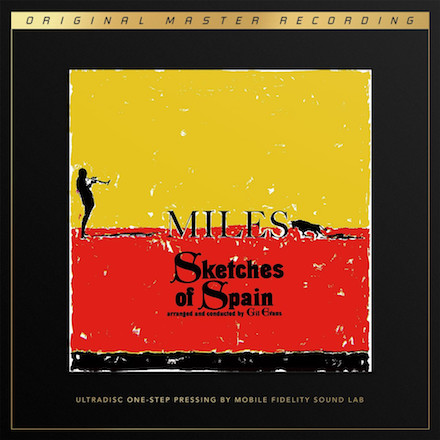
Miles Davis
Sketches of Spain 65th Anniversary Ultradisc One-Step LP
(Mobile Fidelity)
The potent partnership between iconoclastic jazz trumpeter/bandleader Miles Davis and arranger/conductor Gil Evans was proven on tracks like “Boplicity” and “Moon Dreams” from the 1957 compilation Birth of the Cool and albums including 1957’s Miles Ahead. The pair’s work reimagining Gershwin on 1959’s Porgy and Bess and exploring Spanish folk melodies on 1960’s Sketches of Spain would result in Davis’ most tuneful and accessible work. Today, these albums serve as a gateway for pop fans who suspect jazz is elitist or inscrutable. Owing to its source material and concept, the Grammy-winning Sketches of Spain is the more exotic and intoxicating of the two projects while remaining approachable, incorporating post-bop jazz, pop, world music, classical technique, and folk styles.
The treasured album has been reissued many times, including a 2012 pressing in Mobile Fidelity’s Original Master Recording series. Mobile Fidelity has gone a step further for the album’s 65th anniversary, offering the broadest possible soundstage on vinyl via this pristine Ultradisc One-Step LP. The reference project for this review was a clean copy of the 2012 Mo-Fi pressing, which was already an audiophile-quality release. Having heard this One-Step version, it’s hard to imagine a vinyl pressing sounding better. The noise floor on this 180-gram black vinyl platter is negligible and notably lower than the 2012 reissue, with expanded dynamics and minimal reduction in overall level. There were certainly technological limitations to a recording made in 1959-1960, but this marquee project got the best treatment of its day. The separation, balance, clarity, depth, and dimension of each instrument as captured in the original ensemble performance are riveting in this top-shelf presentation sourced from the original master tapes.
José Mangual Sr.’s castanets and Evans’ flute section herald Davis’ entry on the flamenco-inspired opener “Concierto de Aranjuez.” Davis harmonizes with Harold Feldman’s oboe and clarinet, and Janet Putnam’s glistening harp. Trombones add rich countermelody while Paul Chambers’ double bass and Jimmy Cobb’s drums provide direction and a swinging foundation. The breaths of brass and woodwind performers can be heard in anticipation of their notes. Cobb’s brushed snare and subdued cymbal work add subtle texture and propulsion. Davis’ mournful mid-song soliloquy in his lower range via flugelhorn is vivid and lifelike, followed by higher lines that dance atop trills and arpeggios from the group. The piece’s quietest lines possess arresting energy and intrigue. The ensemble follows Chambers’ hypnotic groove into a final section led by Davis’ legato lines on muted trumpet.
“Will o’ the Wisp” is a captivating odd-time piece in which Davis intertwines and harmonizes with the French horn. The top line plays out as a call-and-response with lively brass stabs that incorporate big-band tradition. The piece is drawn from the “Cancion del Fuego Fatuo” section of Manuel de Falla’s romantic ballet El Amor Brujo. The piece concludes with a woozy top line, and the One-Step pressing renders the tubas’ seasick undercurrent with detail.
Davis’ trumpet converses with Evans’ evanescent flutes during “The Pan Piper” before joining Chambers’ bass for an ambling stroll. Trombones and woodwinds harmonize in mesmerizing repetition. An exotic oboe figure leads “Saeta,” which soon yields the way to martial drums and trumpet fanfare. Davis’s solo lingers on legato notes that rise in emotional intensity while the ensemble plays an unsettling drone in the background. Like many of the tracks, the closing piece “Solea” is accented by the percussion of Elden “Buster” Bailey and revered post-bop drummer Elvin Jones (in particular the lyrically-phrased tambourine). The paradoxically hypnotic march highlights Putnam’s harp before moving into an understated but urgent minor-key melodicism from which Davis springs. Again, the One-Step pressing allows discernment of realistic detail that was likely difficult to reproduce on the highest-fidelity systems of 1960.
Sketches of Spain is a significant work of American art, and such passionate and expertly crafted music deserves to be heard in this meticulous and rich setting. Upon its original release, the genre-blending album suggested a new direction for orchestral jazz. Some critics demurred, questioning whether it was even jazz at all. Davis’ famous response quoted later in Rolling Stone was, “It’s music, and I like it.” (mofi.com)
– Jeff Elbel
10 of 10